Showing posts with label Crex. Show all posts

Thursday, June 9, 2022

Crex Meadows, Griggs-Cooper Co. of Saint Paul and the Depression of 1930s

Aunt Pat Schanno Schotl talked about the hard years of the Depression when you were lucky to find work. Neighborhood families shared with those that did not have jobs and food.  Everyone learned  to make do and put their dreams on hold. 


From 1929-1931, Aunt Betty Handler worked for the Crex Carpet Company.  She was listed as a "winder", probably a bobbin winder, and later as an "operator". 


Crex Carpet Company on Front Street, St. Paul MN


The Crex Carpet Company went bankrupt in 1933, but the name "Crex" remained.
During the depression and drought years of the 1930s, further drainage and agricultural attempts failed. By 1940, nearly two thirds of the land in the area was tax delinquent. In 1946, the state purchased 12,000 acres of this tax delinquent land to start the Crex Meadows Wildlife Area 


                                                                                                                                 Crex Grass.


           Crex Meadows Visitor's Center


We have family photos of both female and male employees posed near factory buildings. My mother, Bernice talked about working at the American Can Company  before she was married.  She appears with other female employees at the complex of buildings that we have identified as American Can Company.  The years would have been ca. 1936-1937 as she married in 1938, and did not work immediately after her marriage.  In 1940, according to the Federal Census, Pearl was 19, living at home, and also working at the American Can Company.  She had dropped out of school after her sophomore year.  The family may have needed the money as Grandpa Frank Schotl is not listed as employed in 1940 and may have been ill and no longer able to work.
 
The complex is currently owned by Silgan Container Corporation, a world-wide company founded in 1987.  Silgan acquired the company after their merger with National Can Company. 
 
 Mom also talked about family members being employed at the Griggs-Cooper  Company, but we have not been able to find photos or document it. ..Magdalen Horwath was working as a packer....

Griggs Cooper and Company building circa 1890


In 1913, Griggs, Cooper and Company, later famous for its Home Brand products, completed a large modern factory on the corner of Fairview and University Avenues in St. Paul. This location would have been an easy street car ride taking the Rice Street car and transferring to the University car where the two intersected.

The Griggs, Cooper & Company Sanitary Food Manufacturing Plant at 1821 University Avenue West occupies much of the block bounded by University, Fairview, and Thomas avenues.  It was constructed in 1911-12 with additions in 1921 and 1925. Originally a canning factory and candy and cracker manufacturing facility, the building was reportedly the world’s largest canning factory when built.

The original wing, adjacent to University Avenue, was built to house the Sanitary Food Manufacturing Company Plant. The northeast and northwest wings were built as warehouses that provided space for other functions as well. The three wings of reinforced-concrete construction are similar in appearance and are unified by brick and exposed concrete exterior walls. 

The Sanitary Food Manufacturing Company was a subsidiary of Griggs, Cooper & Company. This facility processed or manufactured several “Home Brand” products in addition to crackers and candy, including coffee, tea, spices, extracts, preserves, and canned fruit and vegetables.


In 1940 Elizabeth Horwath, Apple's sister is living at 582 Prior Ave., very near the American Can Company complex. Apple was married to my uncle Len Schotl. 


Saturday, May 17, 2014

Introducing a few more Kunshiers

When I signed the contract I never saw anything that said I had to write only about dead people.  A recent contact, with newly discovered cousin Jim Kunshier yielded a plethora of new genealogical information for the family tree.  Thanks to him we were able to meet additional cousins, Iris and Lorraine.  


James Michael Kunshier and his wife Ila live in a little town called Grandy, five miles north of Cambridge, Minnesota. Their house has a beautiful view of the surrounding marshes.  The frogs and birds are everywhere.  Jim is the son of Norman C. Kunshier and Betty A. nee Biernat Kunshier.  

He and Ila Mae nee Woolcott Kunshier have three children; Jeremy, Joy and Karina.  They and their spouses and the grand children all live in the area. 


Jim enjoys cooking and gardening.  He is an advocate for straw bale plantings and is willing to share any of his recipes, including one for Bohemian Potato Dumplings. 


Grandy Skyline
 Until his recent retirement, Jim was employed in the Cambridge office of the Minnesota Department of Human Services  as a Human Services Support Specialist.   He is an avid and successful hunter and fisherman and has the pictures and trophies mounted on his walls to prove it.  

Jim may already be regretting his searching me out and laying the cousin thing on me. 


We had the opportunity to spend a couple of very delightful days visiting with Jim and Ila, meeting relatives and touring the countryside.  One evening we were treated to a home cooked meal at their home. After dinner, Jim pulled out his violin and played a few tunes.  The instrument has been in the family for generations but neglected for quite some time.  Jim rescued the instrument and had it carefully restored.  He decided it was time to get on with some violin lessons.  Now he is in demand at family gatherings, senior citizen centers and events at his church.  If he keeps it up, he may need an agent.  


Iris nee Kunshier Baran
The next relative we met was Iris Mae Kunshier who is also my 2nd cousin.  Iris was born April 15, 1925 in Columbus Township, Anoka, Minnesota.  She is the daughter of  Edward Kunshier. 

At age 19 she went to work as a bookkeeper for the First National Bank in Minneapolis. She married Theodore John Baran and they had two children, Gary and Diane.  Her husband died in 1964 and she never remarried.  

We had a chance to meet and visit with Iris, a week before her 89th birthday, at her home in suburban Minneapolis.  She has compiled a 3 Ring Binder that bulges with family photos, memoirs, and documents.  It has been her labor of love for many years.  Particularly exciting was Iris' info on Wassersuppin, a Breakthrough for research in the Czech Republic Archives


Gary Baran
A page form the note book compiled by Iris
Her son Gary and his wife Diane were also there for our visit.  Gary has retired recently from employment with the State of Minnesota.  He also has the genealogy bug and was able to share some family anecdotes and sort out family facts.  


Two days later, Jim drove us to Grantsburg, Wisconsin, to the  home of  Lorraine nee Kunshier Baker.  Lorraine is a daughter of Alexander Kunshier and Esther nee Evgen Kunshier.  Lorraine is my first cousin, once removed.

Lorraine with children, Joan, Janet and Loren
Lorraine nee Kunshier Baker

We spent part of the day with Lorraine and her daughter Janet nee Baker Roberts.

Health issues this past year kept Lorraine in a nursing home for a few months during the winter. She is home now and feeling well enough to have company, though she tires 
easily.


Kunshier, Esther and Lorraine with GF GlaeveThat is me standing tall between Lorraine, on the left, and her mother Esther nee Evgen Kunshier on the right. Not sure where the photo was taken but guessing it may have been in Forest Lake, Washington County, Minnnesota about 1945..

Lorraine told us stories about her growing up years. She remembered staying with my grand parents, Frank and Rose Schotl, and fondly recalled my mother Bernice and my aunt Pearl.  She told a story of attending Grandpa Frank's funeral with the casket placed in the front room of the house on Maryland Ave.   


Lorraine and her extended family

Wednesday, August 7, 2013

Wire Grass and our family connection


In an earlier blog about Grandpa Frank Schotl, I mentioned that we found him listed as a cook on Wire Grass Farm #4, Linwood Township, Anoka County in the 1910 Federal Census. [link to that blog here]  The photo of him in a cook outfit  was one of the photos supplied by Mr. Ken Dufresne to the Anoka County Historical Society.  It was part of the collection that his maternal Grandmother, Mrs. Carl (Martha) Engquist, had saved in boxes and scrapbooks. 


The story about the Minnesota wire grass industry has been  documented by both the Washington and Anoka County Historical Societies and recorded in various area newspapers.  Paul D. Nelson wrote a feature on the wire grass industry in the Winter 2006 issue of the Ramsey County History Magazine.  I have used information from all these sources.   The Tariff Information Surveys on the Articles of the Tariff Act of 1913, by the United States Tariff Commission provided further documentation, and I have also used information that Ken Dufresne shared with us in our interview in July of 2013. 


On our July 2013 trip to Minnesota we had a chance to spend a very delightful morning with Ken Dufresne.    He was very generous with his time and even provided us with a CD with scanned images.  Most of the vintage photos in this blog are from that collection.


Wire grass (Carex stricta) is a species of sedge known by the common name upright sedge. It is grass-like and can be difficult to distinguish from other plants in the sedge family. (source Wikipedia) 


The origin of an industry using wire grass can be traced to Oshkosh, Wisconsin in the mid-1890's.  It was at Oshkosh under the business  leadership of entrepreneur James F. O'Shaughnessy that experiments were begun with wire grass to produce a grass binding twine suitable for harvesting wheat and other cereal crops.  So as Paul Nelson says, "It all began with Twine".


The first attempt at commercial production of wire-grass floor coverings began in 1899 with the organization at St. Paul of the American Grass Twine Company.  "James F. O'Shaughnessy gathered investors and put inventor George Lowry on the case.  Lowry, skilled hand with fiber in the cotton industry devised a machine to twist and join staggered stalks of wire grass..."  (Tariff Information Surveys)

O'Shaughnessy built a factory in Oshkosh only later to decide that it made more sense to locate in St. Paul near a ready supply of wire grass, the binder twine market of the Upper Midwest, and near the fine railroad service available in St. Paul. 

The 1899 charter of American Grass Twine authorized the manufacture of grass-twine mattings for floor coverings, grass-twine furniture, curled grass for bedding and packing, grass bottle covers, grass twine for binding grain, and harvesting machinery.  It was a Delaware Corporation with its main office in New York City, but St. Paul was the center of manufacturing and distribution. 
A number of subsidiary plants were acquired for the production of these goods.  

Prairie Grass Chair (wire grass) in the catalog of Ludwig Bauman store in NYC


Kunshier farms in green, Saxe in red and Heller in blue

In order to be assured of a dependable supply of  grass, the manufacturers either bought up or leased most of the good wire grass meadows in Wisconsin and Minnesota.  They entered into contracts with adjacent farmers whose land was in part covered with wire grass.   It is very possible that the Kunshiers and, or the Schotls were leasing some of their land as their farms were located in areas of wire grass. Estimates for the total area owned or leased by Crex range from 20,000 to 50,000 acres. 


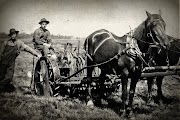
The harvest season opened about the 1st of July, following the preliminary task of draining the grass lands after they have been flooded by the spring thaws.  It continued usually until about the middle of September or until the grass has become too ripe and dry to be fit for manufacture.  Aside from their small contracts with the farmers, the manufacturers assumed direct charge of the gathering of the grass.  For this purpose they established camps not unlike lumber camps.  A camp usually consisted of  Foreman's office, bunk house, dining room and kitchen, machinery warehouse, blacksmith shop, and stable.


Crews of from 24 to 100 laborers were employed at each camp during the harvest season.  All of these men were unskilled except the foreman, machine men, and stackers.  They were paid wages ranging from $3 to $4 per day, in addition to their board.  Harvest crews were supplemented by local men, women, boys and girls.  A few sources also mention that those that provided horses were paid additional for their use.

Women also helped with the harvest


The methods employed in harvesting were controlled largely by two factors: (1) The necessity of obtaining a grass that was properly cured, with spears straight, parallel, and unbroken; and (2) the soggy, unstable character of the peat soil which made it difficult to use heavy machinery unless specially constructed.  In cutting the grass, the self-rake reaper was most commonly used, especially in the smaller meadows.


"Ordinarily, unless a heavy rain had made it necessary to shock them for drying, the bundles of grass were stacked immediately after being tied. After going through a month of 'sweat' in the stack, the grass was ready to be baled; but this was not usually undertaken until the end of the harvest season, owing to the necessity of concentrating all efforts on the harvest during the short season available. The baling was done by a small skeleton crew of workers maintained at each camp through the winter."  (Tariff Information Surveys)

Ken Dufresne's  Grandfather, Carl August Engquist, had been a "gleaner boss" on a crew that harvested wiregrass.  Ken had been raised by his grandparents on their farm  near Wiregrass Camp #3. 


According to Ken, the camps were numbered as they were created:  Number 1 by Wyoming, Number 2 near East Bethel, Number 3 was the South end of Columbus Township, and Number 4 was in Linwood Township.

In 1908 The American Grass Twine Carpet Company changed its name to Crex. The name is derived from the botanical name for Carex stricta referring to the family of wire grass that was being used. 

 
Crex had large warehouses in Forest Lake and Wyoming.  The wire grass was stored until a call came from St. Paul where the grass would be used in a variety of products produced by the Crex Company. 

Today all the  camps which were located in Anoka county are part of the Carlos Avery Game Farm also known as Carlos Avery Wildlife Refuge. The refuge opened in 1937 and eventually comprised a complex of 11 buildings.  It was approved as a project of the Works Progress Administration and today is listed on the National Register of Historic Places.


After leaving Ken, we followed his directions to Camp 3 Road at Potomac Street.  It was near this intersection where he had lived on the old Rumly place and quite near the Schotl farm.  Potomac Street had previously been called Schotl Road. 


From this location we drove North to the Oak Park Cemetery on Notre Dame Street.  Notre Dame Street had once been know as Kunshier Road.  We found more Kunshier graves than we were expecting.  I will write about this and our experiences in Forest Lake in another blog.