Showing posts with label Rondo Neighborhood. Show all posts

Monday, September 15, 2014

Kundschiers in Saint Paul, Minnesota

In the last blog, I wrote about the Kumshers in Iowa.  Thanks to Kornelia "Conny" Pelz, we were able to identify new members of the Kumschier/ Kumsher/ Kunshier/ Kundschier family.  (read that blog here)

We learned that the head of the Iowa Kumshers was Michael, the son of Joseph Kumschier and Mary Kumschier nee Siegl. He was born in Neubauhütten, Wassersuppen, Bohemia in 1869, and died in 1956 in Britt Township, Hancock County, Iowa. 

From an obituary in the Mason City Globe-Gazette of Oct. 16, 1956, we identified his brother, Charles, in St. Paul, Minnesota.  This brother, Karl "Charles" Kundshier, and his wife Anna Turscherl, had established a residence on Rondo Avenue in that city. We have been able to track them for 48 of the 58 years they lived in America. 

Their biographies now appear in Ancestry.com.  We have also listed the Kundschiers in Findagrave.  See that here  Findagrave. 

Charles Kundschier

   Birth: July 24, 1878: Neubauhutten, Wassersuppen, Bohemia (from the Czech Archives, Catholic Church Records for Mother and Father)

  Marriage: June 6, 1904, Age 25, to Anna Turscherl. They have a daughter, Anna. 

  Arrival: 1906, Age 28, His arrival date as he reported it on the 1930 Federal Census. (We have not been able to substantiate this, but we have not yet found a listing in the 1910 Federal Census) 

  Residence: 1916, Age 38.  Living at 470 Rice Street, St. Paul, Ramsey County, Minnesota. According to the Polk Directory of St. Paul, he is working as a laborer . He is going by his German-Bohemian name, Karl. His last name is spelled Kunshier.
   
  Residence: 1918, September 12, Age 40. At the time of of his WWI registration, Charles was living at 470 Rice Street.  He signs the form with an X. He has not become an American citizen. He gives his American name as Charles and he, or the draft board, spells the last name Kundschier.  He is a laborer at the Villaume Box Company. In the Polk Directory of St. Paul he lives with Anna (a Laundress) and Margaret (a Starcher)
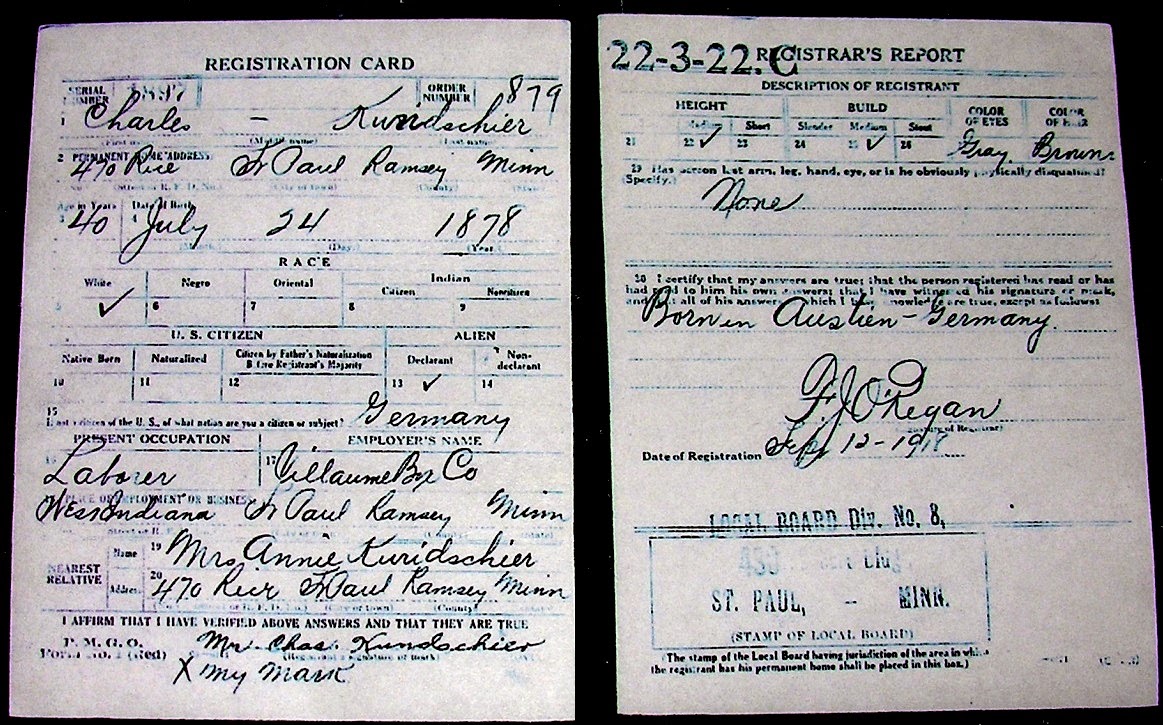


Charles Kundschier WWI Draft Registration, September 12, 1918

  Residence: 1919, Age 41. According to the Polk Directory of St. Paul, he is living at 272 Fuller Avenue and working as a laborer.  He is identified as KARL and the last name is Kumshier. The Kunshiers are also listed. (the house no longer exists and the street is now filled with apartment houses. It was near the intersection with Galtier.) We have not found a listing in the 1920 Federal Census. 

   Residence: 1923, Age 45, He is living at 852 Rondo with his wife, Anna, and daughter Stella. According to the Polk Directory of St Paul, Stella is a clerk at the Emporium, and Charles is working as a Piler for the Villaume Box Company . The last name is Kundschier. The Kunshier's are also listed.

  Residence: 1925, Age 47, Same listing as year before but no mention of wife or children.

  Residence: 1926, Age: 48, According to the Polk Directory of St Paul. He is still in the Rondo house and is a laborer - no company is identified. His daughter Louise lives at home and is a Bindery Worker at Webb Publishing. 

   Residence: 1928, Age 50, According to the Polk Directory of St Paul, Charles is living in the Rondo house, his wife Anna is included and he is a Laborer at the Villaume Box Company. Daughter, Louise, is still at home and working as before.  Last name is again Kundschier.

  Residence: 1929, Charles at age 51, is living with his wife, Anna at the Rondo address. He is working as a Laborer. No Louise listed but son, Charles, Jr is listed under Kunshier with others. Charles Jr. is working at Villaume. 

  Residence: 1930. At the time of the 1930 Federal Census, Charles is living with wife, Anna, Louise and Charles, Jr. at 852 Rondo.  He is a Laborer at a wholesale lumber company as is Charles Jr. (This is probably Villaume in their expansion to lumber products.) Louise works as a Binder. He is listed as coming to the U.S. in 1906, Anna came in 1911. More on this later. (Birth of Children) 

  Residence: 1931-1932. According to the Polk Directories, Charles, Anna L., Charles Jr. and Louise are all living at 852 Rondo. Charles is a Laborer, Charles Jr. is a Helper at Villaume and Louise is still a Bindery Worker at Webb.  Last name is Kundschier.

  Residence: 1933.  According to the St. Paul Polk Directory, Charles, Anna and Charles Jr are listed as previous years, but Louise is gone.

  Residence: 1934. Charles and Anna are still at 852 Rondo. Charles is an Operator at the Villaume Box Company. There is no listing for Louise or Charles Jr. 

  Residence: 1935, Age 57. According to the 1940 Federal Census, Charles, Anna, Charles Jr. and Louise were living at 852 Rondo, five years prior to the Census - hence 1935.  Charles is a Carpenter, Charles Jr is a Bartender, Louise is a Clerk. Last name is Kundschier. 

  Residence: 1937, Age 59. Charles, Anna and Charles Jr are living at 852 Rondo where Charles is a Laborer and Charles Jr is a Trucker for the Seeger Refrigeration Company (where Raymond Kunshier also works.) No Louise listed.

  Residence: 1939, Age 61. Charles, Anna, Charles, Jr and Louise living at 852 Rondo. Charles is an Enameler at Seeger Refrigeration, Charles Jr is a Laborer, and Louise is a Laborer. Last name is Kundschier.

  Residence: Age 62, 1940. Charles and Anna are living alone at 852 Rondo. His citizenship is pending (PA). He is a Laborer at odd jobs.

  Residence: 1950, Age 72, Charles and Anna are living at 852 Rondo. No occupation for Charles. (Charles Jr. is married to Dorothy and living at 566 Edmund Avenue, a few blocks away) Last name is Kundschier. No listing for Louise.

 
Anna Kundschier's grave stone in Calvary Cemetery, St. Paul
Findagrave photo by Dick H. on Sep 12, 2014 

  Death: of his wife Anna, July 2, 1957, Age 78. St Paul, Ramsey, Minnesota.


  Death: of Charles, Feb. 12, 1964, Age 85, St Paul, Ramsey, Minnesota. Death date as listed by the Minnesota Death Index. From a collateral family tree, there is a "Prayer card" issued at his funeral that confirms the date.


Charels Kundschier's grave stone in Calvary Cemetery, St. Paul
Findagrave photo by Dick H. on Sep 12, 2014

                                                         *********************************************************************************


About their residences...

When the expressway was built through the city in the 1960's, many of the houses along Rondo, including the Kundschiers, were demolished. What exists of the Old Rondo Avenue is now called Concordia.  I have written about the Rondo neighborbood in a previous blog. (see it here) 

Both, the Kundschier address at 852 Rondo Avenue, and the address where Charles Jr. and his wife Dorothy later lived at 566 Edmund Avenue, were very close to Saint Agnes Catholic Church.  I am quite certain they were members, and that the church records, when we get to see them, will show family baptisms, marriages and deaths.  


The two places of employment listed for Charles are the Villaume Box and Lumber Company and the Seeger Refrigerator Company.  Charles Jr. was also employed by the Seeger Company.

On October 1, 1882, Eugene and Victor Villaume opened a box- making business on St. Paul's West Side. Villaume Brothers, as it was called, started operations with a loan and some used machinery from the Crippen Trunk Company where Eugene was formerly employed. 


see video here; Villaume Box and Lumber Company


*********************************************************************************

The Seeger Refrigerator Co., founded in 1902 and later known as Whirlpool, was an East Side landmark and American icon for more than 80 years. 


Children of Charles and Anna Kundschier 
 nee Turscherl


Anna M. Kundschier, 1903 – 1974  When Anna M. Kundschier was born on June 12, 1903, in Bohemia, her father, Charles, was 24 and her mother, Anna, was 23. She had six sons and two daughters with Lemuel Will Patraw between 1921 and 1936. She died on April 9, 1974, in St Paul, Minnesota, at the age of 70.

Stella Margaret Kundschier, 1907 – 1987  When Stella Margaret Kundschier was born on April 11, 1907, in St Paul, Minnesota, her father, Charles, was 28 and her mother, Anna, was 26. She married Louis Elmer Joseph Letendre on May 13, 1925. She had four children by the time she was 26. She died on January 15, 1987, at the age of 79.


Louise M Kundschier, 1910 –      When Louise M. Kundschier was born about 1910 in Minnesota, her father, Charles, was 31 and her mother, Anna, was 29. She lived in St Paul, Minnesota, for more than 8 years from 1927 to 1935. We don't have any other information at this time. 

Charles Michael Kundschier, 1912 – 1979   When Charles Michael Kundschier was born on November 5, 1912, in St Paul, Minnesota, his father, Charles, was 34 and his mother, Anna, was 32. He had three sisters. He married Dorothy Schultz.  He died on June 27, 1979, in his hometown, at the age of 66.

                        *********************************************************************************

So, we have Joseph Kumschier/Kunshier, and family in Anoka County, Minnesota; Michael Kumschier/Kumsher and family in Iowa; and Karl/Charles Kumschier/Kundshier and family in St. Paul, Minnesota.

Material from Iris Baran nee Kunshier and Conny provided us with information on Joseph's two sisters. The next blog will be about Anna Kumschier, one of the sisters, and her husband Andreas Irber.

Saturday, January 11, 2014

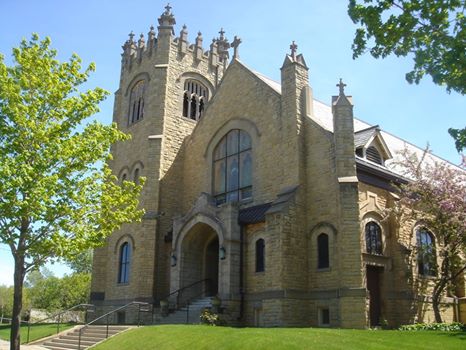
The Lutheran Church of the Redeemer and Old Rondo neighborhood


Lutheran Church of the Redeemer, Dale St and Carroll Ave. MHS collection

I have always had questions about why my father decided to join The Lutheran Church of the Redeemer on Dale Street. It may have had more to do with language than location.  Much of his early schooling and religious training was in German at Emanuel Lutheran, a Missouri Synod Lutheran congregation, on Saint Paul's West side.   In 1939,  he was newly married, and living at 65 Garfield Street, St. Paul.  It was probably at this time that he transferred his membership to Redeemer.  Redeemer was part of the English District, a non-geographical district of the Missouri Synod which was "distinctive among the many immigrant Lutheran congregations because they wanted to give their children the opportunity to worship and receive religious instruction in the English language."


Lutheran Church of the Redeemer from Carol Street


From the time I was born and baptized in 1941 through my confirmation and high school years, this was our church home.  We never lived near the church so transportation was always a problem, doubly so because Mother never learned to drive and either Dad drove or I took the street-car.  None of my school or neighborhood friends went to the church so there was no chance for ride-sharing.    

My father was a strict church attender and made few exceptions for not being in the church pew on a Sunday morning or a church holy day.  I especially never liked the Lenten season when we went to Wednesday and Sunday services and then Easter week added Maundy Thursday, three hours on Good Friday with the Easter Sunday Sunrise Service to top off one long week of church-attending.  And for all this you got a little potted plant to take home after the Sunday service to Mom, who was busy preparing the Easter Meal.  


The church was located in what was called the Old Rondo Neighborhood.  Rondo had served a number of ethnic groups, including Germans and Jews but in the years of the late 1940's, Saint Paul's Black population was concentrating here and was about 50 per cent of the total.   


Joseph Rondeau and his family moved to St. Paul after the family was forced out of their residence near Fort Snelling in 1840. They purchased the property and unfinished cabin of Edward Phelan, then in prison for the murder of John Hays. They lived there for a season or two while building a more suitable house.  Rondeau only stayed a few years but during that time encouraged a number of new immigrants to build on his land.   The Americanized version of his name Rondo was also used for the area’s main commercial street and eventually used to designate the entire area from Marshall to University and Rice to Lexington.  Some years later,  A. L. Larpenteur acquired a parcel of this land on which to build a country estate. 

Auguste Louis Larpenteur MHS


A.L. Larpenteur and
 First Post Office MHS
Auguste Louis Larpenteur, pioneer St. Paul, Minnesota settler, was born in Baltimore, Maryland on May 16, 1823, the son of Louis Augustine and Melinda (Simmons) Larpenteur. He came to St. Paul in 1843 and worked at the store of fur traders William E. Hartshorn and Henry Jackson as clerk and interpreter.  He spoke French and the local native language.  He was also assistant to St. Paul's first postmaster and was involved in the early government of the region. In the 1860's  Larpenteur built his country estate at the corner of Rondo and Dale

Larpenteur country estate at corner of Rondo and Dale  MHS.


The property, at that time, was outside the city limits.  The acreage was equivalent to 10 city lots and known as the Anchorage. He and his wife Mary Josephine continued to add to the house as their family grew to include 10 children. It stood until I-94 was constructed and the house gave way to "progress".   When the house was demolished by the city in 1963, part of the property was used to construct an 150-unit brick nursing home. It was later converted to senior housing. Redeemer Arms bought the building from the The Housing and Redevelopment Authority (HRA) in 1977.   Aunt Eleanor, Dad's sister, spent her last days here. 


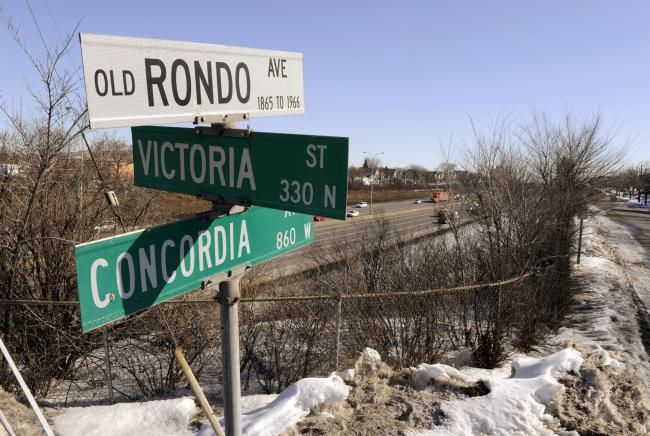
A sign for
A sign for "Old Rondo Ave.: 1865-1966"
stands atop other street signs overlooking
Interstate 94


Recently it was sold to Minneapolis-based Community Development Housing Corporation (CDHC), and after extensive renovation, was reopened as Dale Street Place Apartments.  


In the 1920's through 1940's the Rondo neighborhood was the only place to be if you were Black. "There they could own homes and run their own businesses with little interference from the whites, a rare thing in those days before the civil rights gains of the mid-1960s...we had grocery stores here, there were taverns here, there were restaurants, barber shops. A little bit of everything." 
from article by Patrick Condon in The Current April 2010 (read full article) 

The Rondo neighborhood in Saint Paul was named for Rondo Avenue, which ran east and west for about 1-1/2 miles from Rice Street to Lexington Avenue.  The neighborhood included the  parallel streets to the North and South. Rondo was six blocks North of Selby, and was exactly where Interstate 94 is today. This street and neighborhood were destroyed when construction began on Interstate Highway 94 between Minneapolis and Saint Paul in the 1950s.

Black Churches and social service agencies like Welcome Hall, Hallie Q. Brown Community Center, Inc. and Ober Boys Club were the center of the community. Social clubs were essential to the community because Blacks were not allowed in White-owned hotels, dance halls, or restaurants.

Before the forties a critical indication of social status in the community was by address. The houses at the east end of Rondo, between downtown and Western Avenue, were called Deep Rondo and made up the least desirable neighborhood. The area between Western and Dale was called Cornmeal Valley, the middle ground. West of Dale Street to Lexington Avenue was the more affluent area known as Oatmeal Hill.  

The corner of Rondo and Dale seemed to be where the action was.  Photographer, film-maker and composer, Gordon Parks is proudly claimed by St. Paul and the neighborhood as a former resident although he only spent a few years there.  He was raised in Kansas and when he was 15, upon the death of his mother, he was sent north to live with his sister in St. Paul.  He tells a story in his book, A Choice of  Weapons, about getting dressed up on Easter morning, with two of his buddies in identical forest green double-breasted suits, "the rest of the accessories : brown and white spectator oxfords, striped stiff-bosomed shirts, green ties and gray snap-brim hats" to stand on the corner of Rondo and Dale in front of Field's drugstore, "to give the world a break."

Author Evelyn Fairbanks has her own Rondo and Dale story.  Born in St. Paul, Minnesota, Fairbanks spent a year in Omaha, Nebraska with her natural mother (Eva Mae Riddle) before resettling in St. Paul with George and Willie Mae Edwards. She attended Mechanic Arts High School and became the first black employee at Hamline University in St. Paul, as a cashier.  Later Fairbanks received a bachelor's degree from the University of Minnesota at age 40. 

After the University, she wrote The Days of Rondo, a memoir of growing up in the 1930s and '40s in the thriving Rondo community, the largest Black neighborhood in St. Paul. In her book, she describes her Sundays.  "Every Sunday right after church, most of the black teenagers in St. Paul gathered at Field's drugstore on Rondo and Dale...   When I was sixteen one of my outfits was a grey wool walking suit with a three-quarter length coat, trimmed from neck to hem with silver fox fur, over a black chiffon long-sleeved blouse.  With it I wore a black felt hat with a large grey plume in the back, black  patent-leather high heeled shoes, and a black felt purse, and I carried wrist-length white gloves.  I mean we were dressed to kill"


Fairbanks moved to a 20-acre tree farm near the small town of Onamia, Minnesota after she retired in 1991. Pneumonia in 1993 slowed her down and her breathing was often labored because of asthma. In 1995, she received an honorary doctorate from Hamline.
About that same time, she began her research on Black pioneers in rural Minnesota, hoping to compile her research into a book.  When she died on March 21, 2001, she was working on a book contract; she was also learning Japanese and lecturing to school-age-children.


I got to know the landmarks of Dale Street quite well from the car window, but never ventured down the side streets, with the exception of the basketball games when our church team scrimmaged against one of the Hallie Q. Brown's teams.  Their team usually beat the pants off us.  At home I had perfected a shot for our garage mounted basket on our driveway court.  I would stand next to the house drain pipe, balance on the concrete splash block, and consistently swish the ball.   The shot, however, didn't translate well to the hardwood, and I was lucky if I scored a few points.  Speed and agility were never my strengths.  Hallie Q. Brown Center,  at that time was located on the corner of Aurora and Mackubin.  It relocated in 1972 to the Martin Luther King Center at 270 North Kent Street.  Almost every article or book you read on the Rondo neighborhood mentions the integral part that this center played for the residents through it's long history. 

On Sunday the family would pass through Frogtown and then the Rondo neighborhood before arriving at the church and parking either on Dale or Carroll streets.  We never had trouble finding a parking spot as Dad considered us late if we arrived a half hour before the service began.  Sunday School followed the service so it was always close to 3 hours before we were heading home.  

My "church friends" were all white and most had German names.  I can only think of one exception and that was Charles Avery, a young Black man who lived in the immediate neighborhood.  The Walther League youth group activities and the softball and basketball teams, sponsored by the church, made for some good times.


When I started attending confirmation classes in 1952, one of the sessions was held on Saturday morning.  Since Dad was often at work, it was usually up to me to get there and back via the street-car. 


The weekend street-cars only ran every half hour, so on the trip back home,  I would start walking north along Dale St. waiting for the big yellow street-car to arrive.  I loved the ride and still remember the woven seats, leather straps for holding on if the car was crowded,  and was especially fascinated by the token box which the conductor would continually wind to move the tokens down and into position.


Tiger Jack's shack at the corner of Dale St. and St. Anthony Avenue where he sold hickory chips, kerosene, shoe shines, vegetables and much more always looked interesting but I never ventured in and now I regret that I didn't.  MR. RESPECT is a documentary portrait of the late Tiger Jack Rosenbloom. Made by a class of sixth graders (see it here)

The use of  Tiger Jack as a symbol for the Rondo community is at best problematic.  Little mention is made of the professional doctors, lawyers and businessmen that called Rondo home.  Tiger Jack is the stereotype that whites can handle.  His shack and contents were donated to the Minnesota Historical Society, and in 2003 a one block section of Dale Street was named to honor Tiger Jack Rosenblum and his wife.  


If I made it as far as University Avenue before the streetcar caught up with me, I would forget about riding, pocket the dime, and keep on walking.  It was a little over 3 miles to home on Parkview Avenue from the church, so I still had a couple of miles to go, but there were plenty of things to see along Dale Street through the heart of Rondo and Frogtown.   


Dale Street Shops, Great Northern RR MHS

Further along, I would linger on the bridge over the Great Northern Railway yards just North of  Minnehaha Avenue.  It was a busy place with trains always on the move.  Today with few trains running , the area is called Great Northern Business Park and is home to many small shops and industries.  


a well used Lazy Ike 

But my favorite stop was at Joe's Live Bait where I always checked out the minnow tanks.  They knew me there since Dad and I were frequent minnow customers for our fishing trips to White Bear and Bald Eagle Lakes.  Of course Joe's was not on our way and there were other places to buy minnows near the boat rentals but Dad was a loyal customer and one of my perks was being able to survey the minnows, scoop out those floating belly up and eyeball the new red and white dare devils and Lazy Ike fishing lures.   


Charles Roger's photos in the Murray Pilot yearbook ca. 1956
and 1957
I recently discovered another Rondo community connection. My high school history /social studies teacher,  Charles Rogers lived there.   In a Rondo History oral interview, (read it here) conducted by Mr. David Taylor with Charles Rogers on Sept. 14 of 1997, Rogers describes the difficulty he had in getting housing in St. Paul. His first apartment was above Field's Drug Store at 620 Rondo, on the corner of Dale.  


Mr. Rogers was the first Black male teaching in the St. Paul public schools in the elementary school.  After teaching at both Maxfield and McKinley Elementary Schools, he moved onto Murray High School where he may have been the first Black working for this school in any capacity.  

I was in his classes during those first years and remember writing papers on the N.A.A.C.P and the Urban league and on labor unions.  His background as the Urban League's industrial relations secretary for the St. Paul chapter informed his teaching and provided a unique picture of the black person's urban struggles.   His class lessons were alternative history not found in the standard school books, a window on a different world.

Only after I graduated high school and left town, did Mom and Dad change their memberships to Bethel Lutheran Church on Wheelock Parkway, only a few blocks away from our home on West Parkview Avenue.  It was also a Missouri Synod Lutheran Church.

Dad also purchased a snow-blower since he lost his snow- shoveler to a college dormitory.