Showing posts with label St. Agnes. Show all posts

Thursday, November 13, 2014

St. Paul German-Bohemians (Deutsch-Böhmen)

I begin this blog with as many questions as I have answers.  I also realize the answers that I have now, will not be the answers I have next year, or next month or even next week. As more documents are examined, more books are read, and new contacts are made, this accumulation will need resorting and reinterpreting.  

On October 23-26 2013,  Shan and I attended the Czechoslovak Genealogical Society International Conference in Lombard, Illinois.   This conference appeared on our radar while looking for anything that might inform us on my Bohemian ancestry.  A couple of the conference sessions were specifically on German-Bohemians, and we were just beginning to find out about the German-Bohemians.  It also looked like an opportunity to learn some genealogical techniques from some skilled amateurs and professionals. (see that blog here) 

 So one year later, Shan and I have been doing our homework. This is a brief review of what we have read, people we have met, and what we have learned since that conference a year ago.   We are hoping that you can help us discover even more family stories and documentation. 


Like many genealogists, we are interested in the historical and cultural contexts of peoples' lives, as well as their familial connection.  Germans in Western Bohemia originally came from Bavaria where most of them were farmers.  They were ethnic Germans who were settled along the borders by various Hapsburg powers.  They are referred to as German-Bohemians (Deutsch-Böhmen), and are distinguished from Czech, Slovak and Moravian Bohemians. 

With the help of German Cousin, Conny Peltz, we have discovered that my family, the Kumschier's, were living in the village of Neubäuhütten near Wassersuppen (Nemanice) in the Böhmerwald.  Czech Archives' Catholic Records list the (16) villages in the area as belonging to the Wassersuppen Parish. (Wassersuppen is now called Nemanice)

German Name   Czech Name        Eng. Translation            Status

Gibacht                    Herštenjnské Chalupy   None unknown
HirshsteinhäuselHerštenjnské Chalupy   Noneunknown
PozorkaHerštenjnské Chalupy   Noneunknown
HenrichsbergJindřichiva HoraHenry's Mountainreduced
KreuzhütteKřížová Hut´Cross Hutreduced
HaselbachLiskováHazel Nutsrazed
MauthausMýtniceToll Houserazed
WassersuppenNemaniceWater Soupreduced
NeubauNovosedlyPondrazed
Nimvorgut NuzarovNoneunknown
AlthüttenStará Hut´Old Hutextant
AngerÚporWaterwortrazed
SophienthalČerná ŘekaBlack Riverreduced
SchmalzgrubenNemaničkyLard Pitsrazed
NeubahüttenNovoseldselske HutěPond Forgereduced
FriedrichshütteNová Hut´Frederick's Hutextant
 
It is our hope that we can track the people from this parish to St. Paul in much the same way that Robert Paulson and other members of the German Bohemian Heritage Society (GBHS) have tracked their people to New Ulm, and Susan Muehlhaus-Karides' work on Egerland Böhmisch to Milwaukee.  If we can do this, it will give us evidence of a "chain migration."

We have joined the GBHS (German Bohemian Heritage Society).  The organization was founded in 1984 by Robert Paulson for the purpose of gathering information about the immigration and culture of the ethnic German people from Bohemia to Minnesota. Their headquarters are in New Ulm, Minnesota.  They do have a new, much improved,  website. The site can be accessed (here).  Our contact is Wade Olsen, editor of the German-Bohemian Heritage Society Newsletter. Wade is a frequent presenter at GBHS events. 


Bob Paulson and Shan Thomas at Minnesota History Center
We also had a meeting with Robert (Bob) Paulson, founder, and currently Research Committee chair of the German-Bohemian Heritage Society (GBHS). Bob is generous to novice researchers and the acknowledged expert. 


The book German-Bohemians, The Quiet Immigrants was co-authored by LaVerne Ripley and Robert Paulson (1995, St Olaf College Press, MN).   Most of the book is about the large immigrant population in the area of New Ulm, Minnesota, in the counties of Brown, Cottonwood, and Steele.  Other German-Bohemian communities are discussed in this seminal text.  


In the Border People, I found the following quote interesting and helpful. "There was no single 'Böhmisch' way of life in America, because Böhmisch communities in the old world were border settlements. Each ancestral locale had been shaped by shifting winds of power. The German-Bohemian emigrants were classic border people, with one foot walking in each of two conflicting identities. Their home villages were close to the border between Bavaria and Bohemia. Some knew how to speak both Czech and German. Many had learned to change political and religious loyalties rapidly after a new landlord purchased or conquered their lands. Many were expert in bi-cultural commerce. Many traveled on the same ships, and settled in the same towns, as Czech-identified Bohemians who had lived in the neighboring old-world towns. Some were related to these Czechs by marriage. When they chose their new world homes, they were adept at fitting in. The texture of their community life reflected the realities of power and climate in their new settlements." source: Meter, Ken and Robert Paulson, Border People : the Böhmisch (German-Bohemians) in America, Crossroads Resource Center in collaboration with the German-Bohemian Heritage Society, 1993. 

In a 2003 paper presented by Paulson, he  states, "Beginning with the mid 1850's there was also a significant immigration of German settlers from Bohemia to neighboring Minnesota. There was a sizable group of German-Bohemians who settled in St. Paul, the capital of Minnesota, a city made up of a patchwork of ethnic neighborhoods. The first German Bohemians came to St. Paul in the early 1870's and settled in the German ethnic neighborhoods that ring the downtown area of the city and joined the downtown German Catholic parish of the Assumption."  source: Robert Paulson, "German Bohemian Immigration to North America" (June 2003 paper at SVU North American Conference -Czechoslovak Society of Arts and Sciences  


Again quoting Paulson, "As time went on, each of the German neighborhoods established its own Catholic Church. The largest concentration of German-Bohemians in St. Paul was in the 'Frogtown' neighborhood just north of the downtown business district. These German-Bohemians immigrated from small villages in the forested areas of Southwest Bohemia, the Böhmerwald (Sumava). There were many from the small village of Glockelberg (Zad Zavonka)."  Source: Paulson, Robert, "German-Bohemian Immigration to North America",  Heimatbrief: Stories of German-Bohemians, GBHS/Edinborough Press, 2013.


An article co-authored
by Linda Therkelsen and Robert Paulson is worth reading. It appears in  Heimatbrief: Stories of German-Bohemians,  (GBHS/Edinborough Press, 2013) titled "German-Bohemian Immigration to St. Paul, Minnesota".  They discuss the reasons for emigration and life in the new country with extensive coverage of the Frogtown community. 


Another book we have consulted is They Chose Minnesota, edited by June D. Holmquist  (MHS press, 1981)  German-Bohemians are mentioned in the context of the over-all German migration to Minnesota.  It appears that the value of this book to us may be it's substantial bibliography. 

These are just some of the best English language resources.   There are many German resources that we are just learning about through Cousin Conny Pelz.  GBHS has a research library at their headquarters in New Ulm. (see a list here) 

In addition we maintain our membership in the CSGI.  It offers excellent educational opportunities and  a library. 

Tour check-in by Paul Makousky
On October 24, 2014, we took a guided tour, sponsored by the Czech Genealogical Society International (CGSI), of the 'Saintly City' (St. Paul) exploring its Czech and German-Bohemian heritage.  The guide for the tour was Jim Sazevich, 'The House Detective' aided by Linda Therkelsen "who have collectively spent more than a half-century studying Czech and German-Bohemian history in the state, and the city of St. Paul". source: "Tour of St. Paul's Bohemian Roots" CGSI web site. 


Robert Paulson, Linda Therkelsen and Robert Schuler have done research on St. Agnes.  Church of St. Agnes, St. Paul, Minnesota: Ethnic Origins in Marriage Records, 1887-1897 (Park Genealogical Books, Roseville, Minnesota) Introduction and transcription by Linda Therkelsen. The History of the Church of St. Agnes 1897-1987 by Robert Schuler.  Reading both of these records makes us think the family were not members of St. Agnes. 

We need more research in Catholic Church Records for the three German Catholic churches in St. Paul; Assumption, Sacred Heart and St. Bernard's.


Sacred Hearth Catholic Church  ca. 2014
Sacred Heart Catholic Church was founded for German immigrants in 1881.  The Church is located in the Dayton's Bluff Neighborhood of Saint Paul at 857 6th Street East. The church is about ten blocks from the location where Anna Kumschier and her husband, Andreas Irber, lived and kept store.  I wrote about them in an earlier blog. (see that here) 


I do know that members of the Schotl family, including my Grandmother Rose and my Schotl aunts and uncles, were members of the St. Bernard's Catholic Church in the Rice Street area of St. Paul.  Some also attended St. Bernard's Catholic Elementary and High Schools connected to the church.  

The earliest records are in Assumption and we will attempt to get access.  The Archdiocese of St. Paul usually does not allow the public to see their ministerial records so this may not be possible.

What we would ultimately like to do is track Wassersuppen immigrants to St. Paul, similar to what we did to discover the Burgenland associations in Columbus Township in Anoka County.  That was done with census records and supplemented with Ancestry searches. 

We already know that the immediate Kumschier family and in-laws represent five of the villages in the Wassersuppen Parish.  Can we - with others help - account for all the immigrants from this valley to St. Paul?  Could we compile a master list of sur-names from the villages similar to what Susan Muehlhaus -Karides did for her Egerlanders in Milwaukee?  Stay tuned.  


Grandma Rose and her Geese
After my grandfather Frank Schotl died in 1941, my grandmother Rose nee Kunshier Schotl purchased a house on Jackson Street in St. Paul. The house was small, no running water except for a pump at the kitchen sink. The outhouse was around the back. If you followed further down the path you would come to her large garden and the chicken house. She was pretty self-sufficient and like her German-Bohemian ancestors, she tended a garden, kept chickens, and a gaggle of geese.  From what we have been reading, Rose, although born in America, would have fit right into village life in Neubäuhütten.


Monday, September 15, 2014

Kundschiers in Saint Paul, Minnesota

In the last blog, I wrote about the Kumshers in Iowa.  Thanks to Kornelia "Conny" Pelz, we were able to identify new members of the Kumschier/ Kumsher/ Kunshier/ Kundschier family.  (read that blog here)

We learned that the head of the Iowa Kumshers was Michael, the son of Joseph Kumschier and Mary Kumschier nee Siegl. He was born in Neubauhütten, Wassersuppen, Bohemia in 1869, and died in 1956 in Britt Township, Hancock County, Iowa. 

From an obituary in the Mason City Globe-Gazette of Oct. 16, 1956, we identified his brother, Charles, in St. Paul, Minnesota.  This brother, Karl "Charles" Kundshier, and his wife Anna Turscherl, had established a residence on Rondo Avenue in that city. We have been able to track them for 48 of the 58 years they lived in America. 

Their biographies now appear in Ancestry.com.  We have also listed the Kundschiers in Findagrave.  See that here  Findagrave. 

Charles Kundschier

   Birth: July 24, 1878: Neubauhutten, Wassersuppen, Bohemia (from the Czech Archives, Catholic Church Records for Mother and Father)

  Marriage: June 6, 1904, Age 25, to Anna Turscherl. They have a daughter, Anna. 

  Arrival: 1906, Age 28, His arrival date as he reported it on the 1930 Federal Census. (We have not been able to substantiate this, but we have not yet found a listing in the 1910 Federal Census) 

  Residence: 1916, Age 38.  Living at 470 Rice Street, St. Paul, Ramsey County, Minnesota. According to the Polk Directory of St. Paul, he is working as a laborer . He is going by his German-Bohemian name, Karl. His last name is spelled Kunshier.
   
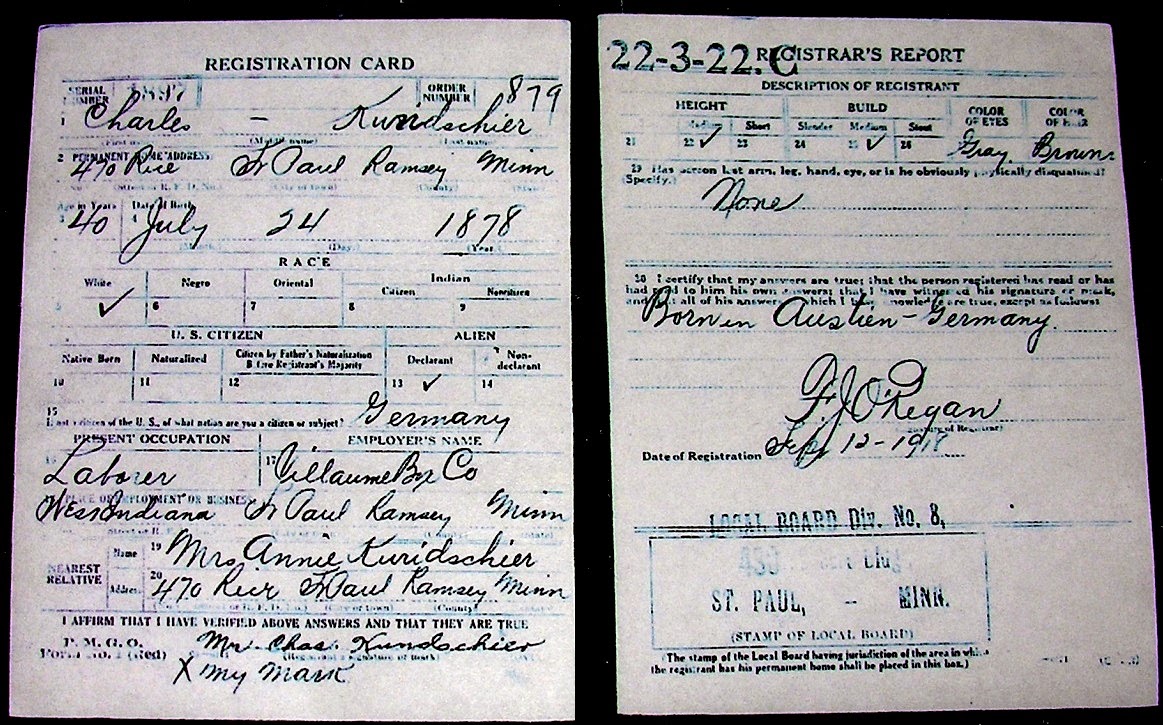
  Residence: 1918, September 12, Age 40. At the time of of his WWI registration, Charles was living at 470 Rice Street.  He signs the form with an X. He has not become an American citizen. He gives his American name as Charles and he, or the draft board, spells the last name Kundschier.  He is a laborer at the Villaume Box Company. In the Polk Directory of St. Paul he lives with Anna (a Laundress) and Margaret (a Starcher)


Charles Kundschier WWI Draft Registration, September 12, 1918

  Residence: 1919, Age 41. According to the Polk Directory of St. Paul, he is living at 272 Fuller Avenue and working as a laborer.  He is identified as KARL and the last name is Kumshier. The Kunshiers are also listed. (the house no longer exists and the street is now filled with apartment houses. It was near the intersection with Galtier.) We have not found a listing in the 1920 Federal Census. 

   Residence: 1923, Age 45, He is living at 852 Rondo with his wife, Anna, and daughter Stella. According to the Polk Directory of St Paul, Stella is a clerk at the Emporium, and Charles is working as a Piler for the Villaume Box Company . The last name is Kundschier. The Kunshier's are also listed.

  Residence: 1925, Age 47, Same listing as year before but no mention of wife or children.

  Residence: 1926, Age: 48, According to the Polk Directory of St Paul. He is still in the Rondo house and is a laborer - no company is identified. His daughter Louise lives at home and is a Bindery Worker at Webb Publishing. 

   Residence: 1928, Age 50, According to the Polk Directory of St Paul, Charles is living in the Rondo house, his wife Anna is included and he is a Laborer at the Villaume Box Company. Daughter, Louise, is still at home and working as before.  Last name is again Kundschier.

  Residence: 1929, Charles at age 51, is living with his wife, Anna at the Rondo address. He is working as a Laborer. No Louise listed but son, Charles, Jr is listed under Kunshier with others. Charles Jr. is working at Villaume. 

  Residence: 1930. At the time of the 1930 Federal Census, Charles is living with wife, Anna, Louise and Charles, Jr. at 852 Rondo.  He is a Laborer at a wholesale lumber company as is Charles Jr. (This is probably Villaume in their expansion to lumber products.) Louise works as a Binder. He is listed as coming to the U.S. in 1906, Anna came in 1911. More on this later. (Birth of Children) 

  Residence: 1931-1932. According to the Polk Directories, Charles, Anna L., Charles Jr. and Louise are all living at 852 Rondo. Charles is a Laborer, Charles Jr. is a Helper at Villaume and Louise is still a Bindery Worker at Webb.  Last name is Kundschier.

  Residence: 1933.  According to the St. Paul Polk Directory, Charles, Anna and Charles Jr are listed as previous years, but Louise is gone.

  Residence: 1934. Charles and Anna are still at 852 Rondo. Charles is an Operator at the Villaume Box Company. There is no listing for Louise or Charles Jr. 

  Residence: 1935, Age 57. According to the 1940 Federal Census, Charles, Anna, Charles Jr. and Louise were living at 852 Rondo, five years prior to the Census - hence 1935.  Charles is a Carpenter, Charles Jr is a Bartender, Louise is a Clerk. Last name is Kundschier. 

  Residence: 1937, Age 59. Charles, Anna and Charles Jr are living at 852 Rondo where Charles is a Laborer and Charles Jr is a Trucker for the Seeger Refrigeration Company (where Raymond Kunshier also works.) No Louise listed.

  Residence: 1939, Age 61. Charles, Anna, Charles, Jr and Louise living at 852 Rondo. Charles is an Enameler at Seeger Refrigeration, Charles Jr is a Laborer, and Louise is a Laborer. Last name is Kundschier.

  Residence: Age 62, 1940. Charles and Anna are living alone at 852 Rondo. His citizenship is pending (PA). He is a Laborer at odd jobs.

  Residence: 1950, Age 72, Charles and Anna are living at 852 Rondo. No occupation for Charles. (Charles Jr. is married to Dorothy and living at 566 Edmund Avenue, a few blocks away) Last name is Kundschier. No listing for Louise.

 
Anna Kundschier's grave stone in Calvary Cemetery, St. Paul
Findagrave photo by Dick H. on Sep 12, 2014 

  Death: of his wife Anna, July 2, 1957, Age 78. St Paul, Ramsey, Minnesota.


  Death: of Charles, Feb. 12, 1964, Age 85, St Paul, Ramsey, Minnesota. Death date as listed by the Minnesota Death Index. From a collateral family tree, there is a "Prayer card" issued at his funeral that confirms the date.


Charels Kundschier's grave stone in Calvary Cemetery, St. Paul
Findagrave photo by Dick H. on Sep 12, 2014

                                                         *********************************************************************************


About their residences...

When the expressway was built through the city in the 1960's, many of the houses along Rondo, including the Kundschiers, were demolished. What exists of the Old Rondo Avenue is now called Concordia.  I have written about the Rondo neighborbood in a previous blog. (see it here) 

Both, the Kundschier address at 852 Rondo Avenue, and the address where Charles Jr. and his wife Dorothy later lived at 566 Edmund Avenue, were very close to Saint Agnes Catholic Church.  I am quite certain they were members, and that the church records, when we get to see them, will show family baptisms, marriages and deaths.  


The two places of employment listed for Charles are the Villaume Box and Lumber Company and the Seeger Refrigerator Company.  Charles Jr. was also employed by the Seeger Company.

On October 1, 1882, Eugene and Victor Villaume opened a box- making business on St. Paul's West Side. Villaume Brothers, as it was called, started operations with a loan and some used machinery from the Crippen Trunk Company where Eugene was formerly employed. 


see video here; Villaume Box and Lumber Company


*********************************************************************************

The Seeger Refrigerator Co., founded in 1902 and later known as Whirlpool, was an East Side landmark and American icon for more than 80 years. 


Children of Charles and Anna Kundschier 
 nee Turscherl


Anna M. Kundschier, 1903 – 1974  When Anna M. Kundschier was born on June 12, 1903, in Bohemia, her father, Charles, was 24 and her mother, Anna, was 23. She had six sons and two daughters with Lemuel Will Patraw between 1921 and 1936. She died on April 9, 1974, in St Paul, Minnesota, at the age of 70.

Stella Margaret Kundschier, 1907 – 1987  When Stella Margaret Kundschier was born on April 11, 1907, in St Paul, Minnesota, her father, Charles, was 28 and her mother, Anna, was 26. She married Louis Elmer Joseph Letendre on May 13, 1925. She had four children by the time she was 26. She died on January 15, 1987, at the age of 79.


Louise M Kundschier, 1910 –      When Louise M. Kundschier was born about 1910 in Minnesota, her father, Charles, was 31 and her mother, Anna, was 29. She lived in St Paul, Minnesota, for more than 8 years from 1927 to 1935. We don't have any other information at this time. 

Charles Michael Kundschier, 1912 – 1979   When Charles Michael Kundschier was born on November 5, 1912, in St Paul, Minnesota, his father, Charles, was 34 and his mother, Anna, was 32. He had three sisters. He married Dorothy Schultz.  He died on June 27, 1979, in his hometown, at the age of 66.

                        *********************************************************************************

So, we have Joseph Kumschier/Kunshier, and family in Anoka County, Minnesota; Michael Kumschier/Kumsher and family in Iowa; and Karl/Charles Kumschier/Kundshier and family in St. Paul, Minnesota.

Material from Iris Baran nee Kunshier and Conny provided us with information on Joseph's two sisters. The next blog will be about Anna Kumschier, one of the sisters, and her husband Andreas Irber.