Saturday, January 11, 2014

The Lutheran Church of the Redeemer and Old Rondo neighborhood


Lutheran Church of the Redeemer, Dale St and Carroll Ave. MHS collection

I have always had questions about why my father decided to join The Lutheran Church of the Redeemer on Dale Street. It may have had more to do with language than location.  Much of his early schooling and religious training was in German at Emanuel Lutheran, a Missouri Synod Lutheran congregation, on Saint Paul's West side.   In 1939,  he was newly married, and living at 65 Garfield Street, St. Paul.  It was probably at this time that he transferred his membership to Redeemer.  Redeemer was part of the English District, a non-geographical district of the Missouri Synod which was "distinctive among the many immigrant Lutheran congregations because they wanted to give their children the opportunity to worship and receive religious instruction in the English language."
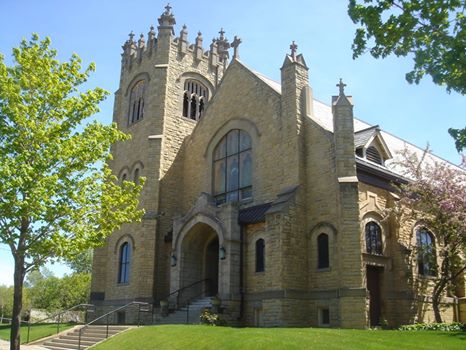

Lutheran Church of the Redeemer from Carol Street


From the time I was born and baptized in 1941 through my confirmation and high school years, this was our church home.  We never lived near the church so transportation was always a problem, doubly so because Mother never learned to drive and either Dad drove or I took the street-car.  None of my school or neighborhood friends went to the church so there was no chance for ride-sharing.    

My father was a strict church attender and made few exceptions for not being in the church pew on a Sunday morning or a church holy day.  I especially never liked the Lenten season when we went to Wednesday and Sunday services and then Easter week added Maundy Thursday, three hours on Good Friday with the Easter Sunday Sunrise Service to top off one long week of church-attending.  And for all this you got a little potted plant to take home after the Sunday service to Mom, who was busy preparing the Easter Meal.  


The church was located in what was called the Old Rondo Neighborhood.  Rondo had served a number of ethnic groups, including Germans and Jews but in the years of the late 1940's, Saint Paul's Black population was concentrating here and was about 50 per cent of the total.   


Joseph Rondeau and his family moved to St. Paul after the family was forced out of their residence near Fort Snelling in 1840. They purchased the property and unfinished cabin of Edward Phelan, then in prison for the murder of John Hays. They lived there for a season or two while building a more suitable house.  Rondeau only stayed a few years but during that time encouraged a number of new immigrants to build on his land.   The Americanized version of his name Rondo was also used for the area’s main commercial street and eventually used to designate the entire area from Marshall to University and Rice to Lexington.  Some years later,  A. L. Larpenteur acquired a parcel of this land on which to build a country estate. 

Auguste Louis Larpenteur MHS


A.L. Larpenteur and
 First Post Office MHS
Auguste Louis Larpenteur, pioneer St. Paul, Minnesota settler, was born in Baltimore, Maryland on May 16, 1823, the son of Louis Augustine and Melinda (Simmons) Larpenteur. He came to St. Paul in 1843 and worked at the store of fur traders William E. Hartshorn and Henry Jackson as clerk and interpreter.  He spoke French and the local native language.  He was also assistant to St. Paul's first postmaster and was involved in the early government of the region. In the 1860's  Larpenteur built his country estate at the corner of Rondo and Dale

Larpenteur country estate at corner of Rondo and Dale  MHS.


The property, at that time, was outside the city limits.  The acreage was equivalent to 10 city lots and known as the Anchorage. He and his wife Mary Josephine continued to add to the house as their family grew to include 10 children. It stood until I-94 was constructed and the house gave way to "progress".   When the house was demolished by the city in 1963, part of the property was used to construct an 150-unit brick nursing home. It was later converted to senior housing. Redeemer Arms bought the building from the The Housing and Redevelopment Authority (HRA) in 1977.   Aunt Eleanor, Dad's sister, spent her last days here. 


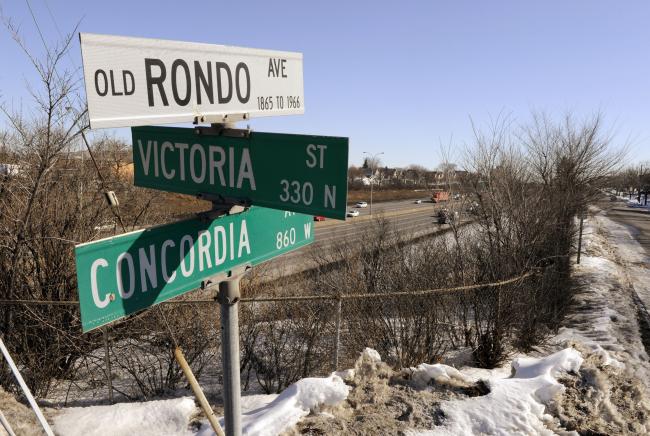
A sign for
A sign for "Old Rondo Ave.: 1865-1966"
stands atop other street signs overlooking
Interstate 94


Recently it was sold to Minneapolis-based Community Development Housing Corporation (CDHC), and after extensive renovation, was reopened as Dale Street Place Apartments.  


In the 1920's through 1940's the Rondo neighborhood was the only place to be if you were Black. "There they could own homes and run their own businesses with little interference from the whites, a rare thing in those days before the civil rights gains of the mid-1960s...we had grocery stores here, there were taverns here, there were restaurants, barber shops. A little bit of everything." 
from article by Patrick Condon in The Current April 2010 (read full article) 

The Rondo neighborhood in Saint Paul was named for Rondo Avenue, which ran east and west for about 1-1/2 miles from Rice Street to Lexington Avenue.  The neighborhood included the  parallel streets to the North and South. Rondo was six blocks North of Selby, and was exactly where Interstate 94 is today. This street and neighborhood were destroyed when construction began on Interstate Highway 94 between Minneapolis and Saint Paul in the 1950s.

Black Churches and social service agencies like Welcome Hall, Hallie Q. Brown Community Center, Inc. and Ober Boys Club were the center of the community. Social clubs were essential to the community because Blacks were not allowed in White-owned hotels, dance halls, or restaurants.

Before the forties a critical indication of social status in the community was by address. The houses at the east end of Rondo, between downtown and Western Avenue, were called Deep Rondo and made up the least desirable neighborhood. The area between Western and Dale was called Cornmeal Valley, the middle ground. West of Dale Street to Lexington Avenue was the more affluent area known as Oatmeal Hill.  

The corner of Rondo and Dale seemed to be where the action was.  Photographer, film-maker and composer, Gordon Parks is proudly claimed by St. Paul and the neighborhood as a former resident although he only spent a few years there.  He was raised in Kansas and when he was 15, upon the death of his mother, he was sent north to live with his sister in St. Paul.  He tells a story in his book, A Choice of  Weapons, about getting dressed up on Easter morning, with two of his buddies in identical forest green double-breasted suits, "the rest of the accessories : brown and white spectator oxfords, striped stiff-bosomed shirts, green ties and gray snap-brim hats" to stand on the corner of Rondo and Dale in front of Field's drugstore, "to give the world a break."

Author Evelyn Fairbanks has her own Rondo and Dale story.  Born in St. Paul, Minnesota, Fairbanks spent a year in Omaha, Nebraska with her natural mother (Eva Mae Riddle) before resettling in St. Paul with George and Willie Mae Edwards. She attended Mechanic Arts High School and became the first black employee at Hamline University in St. Paul, as a cashier.  Later Fairbanks received a bachelor's degree from the University of Minnesota at age 40. 

After the University, she wrote The Days of Rondo, a memoir of growing up in the 1930s and '40s in the thriving Rondo community, the largest Black neighborhood in St. Paul. In her book, she describes her Sundays.  "Every Sunday right after church, most of the black teenagers in St. Paul gathered at Field's drugstore on Rondo and Dale...   When I was sixteen one of my outfits was a grey wool walking suit with a three-quarter length coat, trimmed from neck to hem with silver fox fur, over a black chiffon long-sleeved blouse.  With it I wore a black felt hat with a large grey plume in the back, black  patent-leather high heeled shoes, and a black felt purse, and I carried wrist-length white gloves.  I mean we were dressed to kill"


Fairbanks moved to a 20-acre tree farm near the small town of Onamia, Minnesota after she retired in 1991. Pneumonia in 1993 slowed her down and her breathing was often labored because of asthma. In 1995, she received an honorary doctorate from Hamline.
About that same time, she began her research on Black pioneers in rural Minnesota, hoping to compile her research into a book.  When she died on March 21, 2001, she was working on a book contract; she was also learning Japanese and lecturing to school-age-children.


I got to know the landmarks of Dale Street quite well from the car window, but never ventured down the side streets, with the exception of the basketball games when our church team scrimmaged against one of the Hallie Q. Brown's teams.  Their team usually beat the pants off us.  At home I had perfected a shot for our garage mounted basket on our driveway court.  I would stand next to the house drain pipe, balance on the concrete splash block, and consistently swish the ball.   The shot, however, didn't translate well to the hardwood, and I was lucky if I scored a few points.  Speed and agility were never my strengths.  Hallie Q. Brown Center,  at that time was located on the corner of Aurora and Mackubin.  It relocated in 1972 to the Martin Luther King Center at 270 North Kent Street.  Almost every article or book you read on the Rondo neighborhood mentions the integral part that this center played for the residents through it's long history. 

On Sunday the family would pass through Frogtown and then the Rondo neighborhood before arriving at the church and parking either on Dale or Carroll streets.  We never had trouble finding a parking spot as Dad considered us late if we arrived a half hour before the service began.  Sunday School followed the service so it was always close to 3 hours before we were heading home.  

My "church friends" were all white and most had German names.  I can only think of one exception and that was Charles Avery, a young Black man who lived in the immediate neighborhood.  The Walther League youth group activities and the softball and basketball teams, sponsored by the church, made for some good times.


When I started attending confirmation classes in 1952, one of the sessions was held on Saturday morning.  Since Dad was often at work, it was usually up to me to get there and back via the street-car. 


The weekend street-cars only ran every half hour, so on the trip back home,  I would start walking north along Dale St. waiting for the big yellow street-car to arrive.  I loved the ride and still remember the woven seats, leather straps for holding on if the car was crowded,  and was especially fascinated by the token box which the conductor would continually wind to move the tokens down and into position.


Tiger Jack's shack at the corner of Dale St. and St. Anthony Avenue where he sold hickory chips, kerosene, shoe shines, vegetables and much more always looked interesting but I never ventured in and now I regret that I didn't.  MR. RESPECT is a documentary portrait of the late Tiger Jack Rosenbloom. Made by a class of sixth graders (see it here)

The use of  Tiger Jack as a symbol for the Rondo community is at best problematic.  Little mention is made of the professional doctors, lawyers and businessmen that called Rondo home.  Tiger Jack is the stereotype that whites can handle.  His shack and contents were donated to the Minnesota Historical Society, and in 2003 a one block section of Dale Street was named to honor Tiger Jack Rosenblum and his wife.  


If I made it as far as University Avenue before the streetcar caught up with me, I would forget about riding, pocket the dime, and keep on walking.  It was a little over 3 miles to home on Parkview Avenue from the church, so I still had a couple of miles to go, but there were plenty of things to see along Dale Street through the heart of Rondo and Frogtown.   


Dale Street Shops, Great Northern RR MHS

Further along, I would linger on the bridge over the Great Northern Railway yards just North of  Minnehaha Avenue.  It was a busy place with trains always on the move.  Today with few trains running , the area is called Great Northern Business Park and is home to many small shops and industries.  


a well used Lazy Ike 

But my favorite stop was at Joe's Live Bait where I always checked out the minnow tanks.  They knew me there since Dad and I were frequent minnow customers for our fishing trips to White Bear and Bald Eagle Lakes.  Of course Joe's was not on our way and there were other places to buy minnows near the boat rentals but Dad was a loyal customer and one of my perks was being able to survey the minnows, scoop out those floating belly up and eyeball the new red and white dare devils and Lazy Ike fishing lures.   


Charles Roger's photos in the Murray Pilot yearbook ca. 1956
and 1957
I recently discovered another Rondo community connection. My high school history /social studies teacher,  Charles Rogers lived there.   In a Rondo History oral interview, (read it here) conducted by Mr. David Taylor with Charles Rogers on Sept. 14 of 1997, Rogers describes the difficulty he had in getting housing in St. Paul. His first apartment was above Field's Drug Store at 620 Rondo, on the corner of Dale.  


Mr. Rogers was the first Black male teaching in the St. Paul public schools in the elementary school.  After teaching at both Maxfield and McKinley Elementary Schools, he moved onto Murray High School where he may have been the first Black working for this school in any capacity.  

I was in his classes during those first years and remember writing papers on the N.A.A.C.P and the Urban league and on labor unions.  His background as the Urban League's industrial relations secretary for the St. Paul chapter informed his teaching and provided a unique picture of the black person's urban struggles.   His class lessons were alternative history not found in the standard school books, a window on a different world.

Only after I graduated high school and left town, did Mom and Dad change their memberships to Bethel Lutheran Church on Wheelock Parkway, only a few blocks away from our home on West Parkview Avenue.  It was also a Missouri Synod Lutheran Church.

Dad also purchased a snow-blower since he lost his snow- shoveler to a college dormitory. 


Saturday, November 23, 2013

at the Czechoslovak Genealogical Society International Conference


In October of 2013 we attended the Czechoslovak Genealogical Society International Conference  in Lombard, Illinois.

This conference appeared on our radar while looking for anything that might inform us on my Bohemian ancestry.   If it didn't help in understanding the Kunshier's world, it looked like an opportunity to  learn some genealogical techniques from some skilled amateurs and professionals.

An additional prompt was finding Rosemary Ruffenach's  article about her Grandmother's Fur Coat in the March 3, 2011 Twin Cities Daily Planet.   

 Rosemary writes: "the coat would have graced Grandma's shoulders during Mass at St. Bernard's Church in Saint Paul's North End community (home to Austro-Hungarians and Bohemians), and to meetings at the St. Bernard's Little Flower Mission Club, as well as visits to her extended family scattered throughout the North End....  

Many of my maternal family members attended St. Bernards and grew up in the same neighborhood that Rosemary mentions in the article.  It was the church of my mother and her family.  My parents were married in the rectory by the parish priest. 

We filled out membership forms on-line, paid our conference fees, and bright and early on a Thursday morning were on our way to the Westin Hotel in Lombard, Illinois.   Never having been to Lombard, but confident we would get there eventually, we wandered on.  In hindsight, this was not the smartest approach, but we did manage, after a couple of gas station and fast food location inquiries to pull up to the Postmodern shopping center that harbored the Westin Hotel. 

"Before you can begin your search in the archives of the Czech Republic, it's necessary to have, at the very least, the name of your Czech ancestor and the name of the village where they lived prior to emigrating." ... cautions from the Czech Archives 

Well, we had some names but didn't have the village. We had great grandparents identified as Bohemian in the 1910 Federal Census.  We were hoping, by some miracle,  to discover their village during the course of a presentation or from a crucial clue provided by a fellow participant between bites of the luncheon chicken salad sandwich.

We had arranged for cat feeding and a place to stay.  The first was provided by friend Jim Lookabaugh and daughters. The later was provided by Shan's daughter Monica and husband Mike at their home in Wilmette.  Entertainment and drama was provided by their daughter Teagen and Stewart the cat and Madison the dog.  

Shan had posted this query to the C.G.S.I. member's web board. "Wasshobon, Where is it? The last name is Kunshier, Joseph and wife, Marie Katherine (nee Teller.) Neither Joseph Sr. or his son, Joseph Jr. identify their home village on their Declarations of Intent to become U. S. citizens. Of the other two sons born in Bohemia, one does not apply and dies as a young adult, leaving the third son, Charles who gives his place of birth as Wasshobon, Austria on his Declaration of Intent. 

Previous to our trip, Shan spent some time at the State Historical Society of Wisconsin looking through the Leo Baca indices for Kunshier embarkation logs. 

 
She did find that Josef (Joseph)  Kunscher (Kunshier) embarked on the German Lloyd ship "Nurnberg", from Bremen, in September of 1884. He landed in Baltimore with Josef Jr., age 15, and Michel, age 13, on October 15.   Left behind, to come later, were Marie (Mary) and the other 3 children.  (On one of the census, Maria gives her arrival date as a year later than Joseph's).


The first conference session that I attended was Documenting Czech Immigrant Arrivals by
Leo Baca.  Leo is a Czech Texan whose primary interest in documenting the arrival of Czech immigrants to America. 

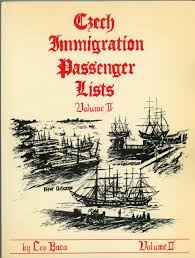
 He has conducted Czech genealogical research for more than 30 years and has published the nine-volume Czech Immigration Passenger Lists series.
  
His session included information about ship passenger lists, Internet sources, and his publications. 
 
The 2nd session I attended was Homes of Our Czech Ancestors in the Old Fatherland by Miroslav Koudelka.  Miroslav  has been a professional genealogist since 1993.   He also serves as a guide in the Czech Republic, and interpreter.  He translated into English the History of Czechs in America by
 Dr. Jan Habenicht.  


Informative and interesting for the wider context but not our narrower quest.


Shan attended two sessions with Czech genealogist Jan Dus.
The Czech Republic has great records for the Catholic Church, census, land ownership, and European based genealogy.  Many of the records have been digitized.  
 
 She was very impressed with the extensive resources that are available in the Czech Republic. 


Shan Thomas consulting on the Kunshiers with Pam Peltier.


The conference also provided scheduled time to use the CGSI traveling library and a private consultation with a trained volunteer genealogist.  Pam Peltier helped with our search and, while she tried every thing she could think of, we were still left scratching our heads about the name of the village.
 
 One of the books we searched in the volumes brought to Lombard  was the  Berni Rula, a 1654 Bohemian civil census. Land owners names and property are recorded and published by area of the country.  The two volume alphabetical name index lists name of taxpayer, how many fields owned, listing of livestock, social position, etc.


We didn't find Kunshiers in this census, but did find two families of Streckers, Caspar and George. In our family tree, Emma Kunshier, a sibling of Grandma Rose Kunshier married George Strecker  and the Kunshiers and Streckers continued as neighbors in Anoka County.  Maybe a connection, maybe not.  
The complete Czechoslovak Genealogical Society International Library is housed within the Minnesota Genealogical Society (MGS) Library in St. Paul, Minnesota and perhaps worth a look during a future trip. [directions and more info here]
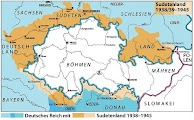
All of this was helpful for a broader context but not specific enough for our search.  We came to the conclusion that the ancestors we were looking for were probably German speaking Bohemians who had come from the border districts of Bohemia. This area is also  referenced after the First World War as The Sudetenland. Today it is part of the Czech Republic


Wade Olsen
 The conference presenter person who seemed most informed about the German-Bohemians  was Wade Olsen.    He has focused much of his research and time on the central European region including the western Czech Republic and eastern Bavaria.  I attended both of his sessions on German-Bohemian Immigrants and their culture. 

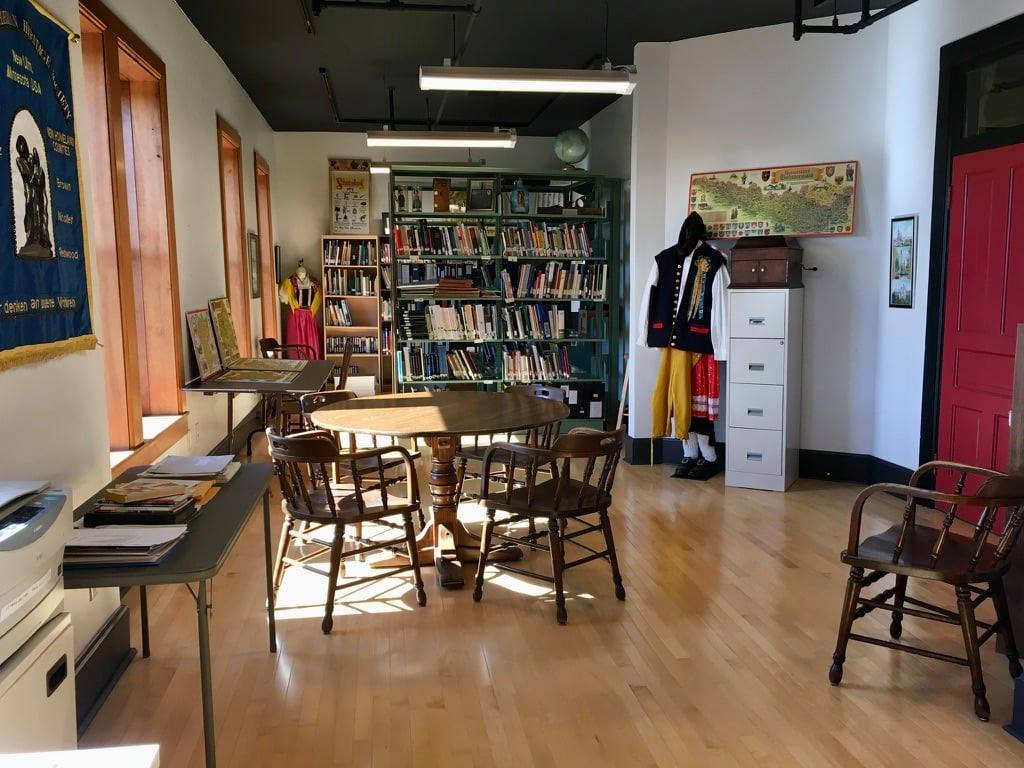
Wade now lives  New Ulm, Minnesota where many of the German-Bohemians settled.  He is the current editor of the German-Bohemian Heritage Societies newsletter.  New Ulm is also the headquarters of the German-Bohemian Society and home to their library and research facility. 


His predecessor as editor was Robert Paulson who was also the society founder.   Many of the early issues of the newsletter,The
Heimatbrief , are available on line.


A few years ago during a trip to the Minnesota History Center in St. Paul, we had purchased the book,  German Bohemians; The Quiet Immigration.  It was written by Laven J. Rippley with much of the research  information, and many photographs provided  by Robert Paulson. 
Both Shan and I  gave it a cursory look at the time but because it was so focused on the New Ulm community, we put it into the "to be read later" pile.   Now is the time to give it a 2nd look.


"The German Bohemians almost became a lost people. It is extremely difficult to track their life in America. Few archives recognize the existence of the German-Bohemians as a distinct cultural group. Usually they are lumped together with other nationalities. Some census-takers listed them as Austrian, since their homeland was under the rule of the Austrian Empire when they immigrated. Some were labeled as German because of the language they spoke. Still others were called Bohemians, a term which hardly distinguished them from their Czech neighbors. In fact, in the 1905 Minnesota census, Brown County, the home of the most German Bohemians in Minnesota, was noted to have the second-largest Czech population in the state, when in fact there were only two Czech speaking families in the County. Not until the 1920s census were the Bohmish listed as German speakers from Bohemia." ... Robert Paulson “German-Bohemian Immigration to North America” Selected Papers from the 2003 SVU North American Conference, Cedar Rapids, Iowa, 26-28 June 2003


 After the conference, Shan scrolled for hours through the embarkation records from Hamburg and the Baltimore debarkation records for the years 1884-1886. The hope was to find additional Kunshiers on the ship manifests.

 Going forward, there is still hope that we can recover some information about Kunshiers in the Minnesota Roman Catholic Archdiocese records. The two locations would be at St. Agnes in St. Paul or at St. Peters in Forest Lake.  We have gathered names of possible living Kunshiers from obituaries, Ancestry.com listings, and the white pages of  telephone directories in Minnesota and Wisconsin.  We formulated a letter to send to any Kunshiers that may help in the quest.


The conference was very encouraging.  If we can find the Bohemian home village, we may have a wealth of information waiting for us in the Czech Republic.
  
We have since found the village name to be:  
Neubauhutten, Wassersuppen, Bohemia

Wednesday, September 25, 2013

Charlie Deutsch, Pat Schotl's Memorial Service, Calvary Cemetery


This blog results from the trip that Shan and I made to the memorial service for Aunt Patricia Schanno Schotl on September 14th, 2013.  We had planned to meet with Pat sometime in October to learn more of her history and continue filling out the Schanno family tree.  Unfortunately, before we could meet again, she passed on and left a void for all who knew and loved her.  We wanted to share in the remembrance and celebration of this woman so we decided to make the trip and attend the service. 


As stated in the Memoriam blog I had just renewed a contact with Pat that had been lost many years before.  I knew a little about her but less about her children and their lives.  I remember meeting Sandi, her oldest daughter, and the two older boys Craig and David.   Jean and Dianne, the two youngest girls and Rob, the youngest son, were all born after I left St. Paul.  I wondered if I would recognize anyone at the service and what kind of reception we would receive, based on the fact their father, my uncle, Herbert James Schotl, had not been there for them for most of their growing up years. 


After the separation and divorce from Pat, he remarried and had little or nothing to do with his children.  He died December 31 of 1997 and was buried in Fort Snelling Military Cemetery. 


We had little opportunity to meet or talk to anyone before the service with the exception of Pat's brother Dell Schanno and his wife Janet.  They live in Wirt, Minnesota and had made the 4 hour trip to St. Paul in the morning and planned to return after the service was over.

Janet had her own story to tell as a couple of months before she had become disoriented while picking blue berries and spent the night in the woods with the whole county looking for her.

We introduced ourselves after the service to Jean and her brother David.  I don't think it registered at the time that we were first cousins.  We did talk to some of the women from Aunt Pat's apartment building and met two ladies, the Benton sisters, who were related to Pat, and grew up on Western Avenue just off Front Street.  While we wished we could have met more of the family we were happy we went and paid our respects. 


St. Paul is about a four hour trip from Mount Horeb, so when we make the trek we usually try to combine a number of visits with genealogy research. We had been in contact with a Mr. Charlie Deutsch through the  Burgenland Bunch site and had been wanting to meet and talk to him about some of  my relatives and their neighbors who were from Northern Burgenland.  These people emigrated to the Midwest from a small area surrounding the town of Monchhof.  They came as farmers and tradesmen.  Some bought farms while many took up residence in St. Paul's Rice Street Neighborhood and nearby "Frogtown".

   Map of St. Paul with Frogtown center left 

Shan had sent Charlie some family names we were researching and he told her he would do some checking.  He agreed to meet with us on that Friday and we set the time and place at the Barnes and Nobles on Snelling Avenue.  After swapping some St. Paul stories and  learning about each other, he brought out his lap-top.  Most of the records we were interested in he personally entered into a spread-sheet from the Saint Bernard Church and School records.  "The Church of Saint Bernard's Baptism, Marriage, and Death records have been digitized for the years from 1890 - 1940.  The Grade School records have been digitized for the years 1890 - 1955.  

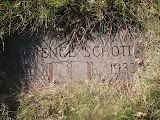
As it turned out on Sunday morning, we had some time before heading down to Onalaska to visit with my sister Kayleen and Larry White, her husband.  We made a quick visit to Calvary Cemetery on Front Street in St. Paul.  My Grandfather Frank Schotl, his son Lawrence, and my Great Aunt's husband John Handler Jr. are all buried there. We had never visited their graves.  Shan had obtained a cemetery map from the office so we knew where to look.  Calvary is a huge cemetery located on Front Street, West of Dale Street, serving  St. Paul's Catholic community with over 100,00 burials.


After our time in the cemetery, and as we headed out of town, we drove down Front Street through the Rice Street area.  We wanted to see if we could locate the building or buildings that are in photos we have of Herb and Len Schotl


photo is of Diva's on Rice Street with St. Bernard's in background

The building now on the right is used by The International School of Excellence, a Hmong School which is located in what was formerly a Saint Bernard's School building.  Saint Bernard's  Grade School closed in 2009 and the High School closed in 2010.   


The photo on the left was taken ca. 1945.  As we drove up Geranium to Rice Street we realized we had found the same spot. 


                The photo on the right was taken Sept. 2013.  


The building across the street is now the DeLisle Co. Realty. 


The photo on the left was taken ca. 1945  from behind the bar on the corner.  The photo on the right was taken Sept. 2013 from about the same spot.  The distinctive black lines can be seen on the brick on both photos.

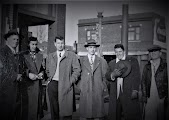
  This photo is of the back of the bar ca. 1945 with both Herb and Len Schotl and unknown 3rd person.  Nobody seems to know why they were meeting back there. Probably not to discuss politics.


                                                                        The place matching photo is  from September, 2013

                                                                                      The vents, grated window and electrical                                                                                                    connections looked very much the same.  


We are hoping Charlie can help ID some of the other men in the older photos. 

                                                             Herb Schotl is 3rd from left

                
Herb Schotl is on the right


My father and mother lived briefly at 1001  Matilda Street.  Old Fire Engine House 22 was located down the block at the corner of Front and Matilda.  After Dad was employed by the St. Paul Fire Department he spoke with fondness of being able to renew his acquaintance at that location.  In his job as Superintendent of Apparatus, he was in charge of keeping the equipment and vehicles in good running order and frequently did testing at that station.


Originally built in 1887, this was a single-bay, two-story house.  It first housed Supply Hose Number 5.   On October 8, 1912, Hose 5 was replaced by Engine 22.  A 1940 report stated that it had been "completely rebuilt and modernized into a bungalow-type station with sleeping quarters in the rear."  In 1958, the new [present] station was built at Front and Marion, housing Engine 22 and Ladder 3.  


The old fire house building still stands and is used for storage by Viking Sign Supplies.

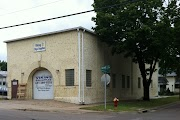
Shan also took a photo of an interesting brick building a few blocks down Front Street on the corner of North Albemarle.  It was a corner grocery as the beginning of the name is visible at the top of the structure.  It was nice to see the old sign painted on the side so nicely preserved.  I hope we can find out more of the store's history.  The building now serves as a residence.
 

As a very nice conclusion to this blog, I am pleased to say that Pat's daughter Jean called and we talked for quite a while putting together some of the family puzzle .  She appears as happy as I am to have found a new cousin.  She knows very little about her Father's side of the family and seems interested in learning about him.  

Also later in the week there was an email contact from Jessica Good Anderson, a daughter of Pat's daughter Dianne.   She is also interested in working on her family tree.  I told her I would help if I could. 

Pat Schanno Schotl and Jessica Good Anderson

Thursday, September 12, 2013

In Memorium: Patricia Anne Schanno Schotl, 1928-2013


In Memorium: Patricia Anne Schanno Schotl, 1928-2013

Much of this blog was written before we learned of Aunt Pat's passing.  We were aware of some of the health problems she dealt with daily, but when we saw her she was cheerful, happy for the visit, moving about preparing lunch and all the while chatting away about the kids and the neighbors, her card games and trips to the casino.  We spoke to her after our visit and planned to see her in October.  We were very surprised and saddened when a family member sent us the obituary from the Sunday paper of September 7.
 

We concluded our July 2013 Minnesota trip with a  visit with Aunt Patricia Schanno Schotl at her residence, in a senior apartment building on Larpenteur Avenue, in Roseville.  

Earlier in the summer, Shan and I composed a letter to her and two of her children.  We found addresses through Internet searches and sent a letter that detailed our forthcoming visit and our wish to meet and share experiences with them.   A  few weeks later there was a phone call from Aunt Pat.

She had just returned from a "grandchild wedding up north" and found our letter.  "When can you come?... can you stay for lunch?  I'll make Fajitas. Do you like Fajitas?"


Pat Schanno Schotl with first child Sandi


Pat's paternal grandfather, Herbert John Schanno, was born on December 28, 1880 in Minnesota. He married Molly Deiters.   Their son Clinton and daughter Iona were adopted.

According to Pat, Herbert owned a dairy farm near the Pearson Candy factory along West 7th Street near downtown St. Paul.  He also worked as a milk tester.  He  died at the age of 46 on December 17, 1926 and is buried in Roselawn Cemetery, Roseville, Minnesota.  


Molly was born on Nov. 1, 1882, and died on June 20 1974. She is also buried in Roselawn Cemetery.                                              


Pat's father, Clinton/Clifton Schanno was born April 5th , 1906 in West Saint Paul. He married Pat's mother Helen A. Love.  They had three sons and one daughter. He died in Wirt Minnesota on his birthday in 1964. He is buried in Acacia Cemetery, Mendota Heights, Minnesota.  Her mother, Helen, was born on October 8, 1907, in Wisconsin.  She died on July 27, 1945 at the age of 37, and is buried in Calvary Cemetery,  St Paul..


Patricia was the first born of the four, 
the only sister to Don, Del and Thomas


Pat's adopted brother Delbert

Pat's brother Don and his wife 
Bernice nee Reuskins


.  She grew up in the Rice Street area of Saint Paul and went to Smith Elementary School and then to Washington High School where she graduated in 1946.  


Smith School at Geranium and Sylvan


She recalled the hard times of the Depression when she put cardboard in her shoes and her Dad had earned money by "dare boxing."  "He used to come home with black eyes."   She said he also talked about his cooking for the railroad guys but didn't know if it was a job with the railroad or if he had cooked for some of the hobos down by the railroad yards.  Her father's given name was Clinton, but somehow or for some reason, it had been changed to Clifton.  "It may have been to avoid the bill collectors."  A photo she seems to especially treasure is one of her father with her brother Donald and his first deer.


According to the 1931 and 1932 St. Paul City Directories, Clinton was living with wife Helen and young family at 1034 Crowell Ave, St. Paul.  Patricia was aged 6.  He was employed as a driver for St. Paul Milk Company. The family then moved to 63 Jessamine Ave. and he was working as a truck driver for Baldwin Transfer Co.  His wife, Helen Love Schanno died on July 27 of 1945.   Her Father remarried in 1946 to Helen M Kuebelbeck and continued to live in the  house on Jessamine.  After her Mother's death Pat moved out and lived with a neighbor.  In 1948 Clinton was employed as the "Recording Secretary for St. Paul General Drivers, Union Local 120".


Enter the scene, a dashing young soldier, my Uncle Herbert James Schotl, the youngest sibling of my mother, Bernice Schotl Glaeve.  He was discharged from the Army in January of
1946, and  returned to St. Paul. 

He was living with his mother on Jackson Street and was hanging around the Rice Street area with a few army buddies and neighborhood chums. According to Aunt Pat, "It was a rough group and they were and up to no good." 


One evening, as Pat was on the way to dinner at the home of one of her friends, she chanced upon Herb and he asked her to a movie.  She knew who he was and because of his reputation, she wanted nothing to do with him.   She declined the invitation but he later showed up at the friend's house and the rest is mushy history.  They were married in March of 1948.


As a young pre-teen boy I had known her as Aunt Pat.  My only lasting memory is of a visit with her in an upstairs apartment somewhere in the Rice Street area.  I don't think Herb was there and if there was a child, it was of the wee size.  She sat on a large over-stuffed green chair and smoked a cigarette.  When I showed her the photo she said, "Well I haven't smoked for 45 years". 


Herb and Pat were parents to 5 children.  They were Sandi (1948), Craig (1954), David (1958), Jean (1960) and Dianne (1963). 
  
 They were living at 1123 Albemarle Street, about a block from St. Bernard Catholic Church where the children were baptized.  The children attended St. Bernard Elementary School and at least some attended St. Bernard High School.
 

Children of Herb Patricia Schotl with Grandma Rose, ca. 1964
from left Craig (1954) Jean (1960) Dianne (1963) Sandi (1948) David (1958) 


Ultimately the marriage ended in separation and divorce.   Pat told us that she went back to school and earned a nursing degree at the College of St. Catherine (St. Kate's).  She said the kids were a great help as she was getting her education. After a number of inquiries it seems that this must have been a dream as there is no record of her ever attending St. Kate's or earning a nursing degree. 


Sandi's Highschool class photo


Sandi married James Koktavy in 1967 and was living in Arizona when she was diagnosed with cancer.  She died on May 21 of 1999 in a hospice care facility in Coon Rapids Minnesota.  At the time of her passing, the other children, including Pat's last son Rob, were alive and  very much a part of Pat's life.


David Schotl


In Pat's apartment there were child and grand-child pictures everywhere. "I have so many pictures I have to change them according to who is coming for a visit" she commented.   When Shan asked her how she kept them all straight she said "Oh I just call them all honey".

                Daughters Dianne and Jean


Her brother Donald became very interested in "where everybody was buried".  He spent time at the Courthouse inquiring about records and traveling to cemeteries.  "He always wanted me to go along but I never did... He kept notes and drew small maps on 4" x 6" index cards of the cemeteries with burial locations." 

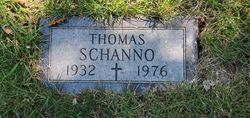
 Her brother Thomas Schanno was disabled from birth and was institutionalized for most of his life.  Pat made time to visit and make sure he was getting good care.  "Of course I always took candy for his friends so they were always happy when I came to see him."

Thomas is buried at Saint Mary's of the Lake Cemetery, 
White Bear Lake, Minnesota


 Shan and I hope to expand Pat's story to share with family and friends.  We would like to hear from any one who has corrections or additions to what we have written so far, or would like to share their memories of this wonderful, courageous woman.  You may use the "Post a comment" section below to make a contact or to share your memory.
 
Rest in Peace Aunt Pat.  You have been an inspiration.   Gerry Glaeve and Shan Thomas, September 11, 2013.