Sunday, March 9, 2014

Living in the Como Park neighborhood


I thought it was time to say some more about growing up in the Como area of St. Paul.  I have written previously (see that here) about the first house my family owned on Parkway Drive and the move to the house in the Como area on Parkview Avenue.  Officially, the Como neighborhood is bounded by Falcon Heights and Roseville on the North, the Railway on the South, Dale Street on East and Snelling Avenue on the West.  


My neighborhood during elementary school years was more restricted.  I was allowed to wander as far east as Dale Street with it's playground.  There was small basement grocery store on the corner of Arlington and Dale, the Ardale, where I was often sent for bread and milk.   My southern limit was Maryland and when I started going to confirmation classes at The Lutheran Church of the Redeemer on Carroll and Dale I needed to walk to the very edge of my world to catch the streetcar.  The tracks began at Dale and Maryland.  Though we were allowed to go north of Arlington to Larpenteur, we knew there were only houses and thus seldom ventured in that direction. 

It was the lake, the park or the zoo that received most of our attention.  And there weren't any restrictions as long as the chores were done and we were home at the appointed time. Fishing poles in the summer with brown bag lunches stuck in the bicycle saddle bags, hockey skates and sticks slung over our shoulders in the winter, and we would head west.  Everything was free, no admission fees period.  I know it was one of the best possible places to grow up. Those were great times and I have good memories.  


Patricia Hampl, one of my favorite St. Paul writers, makes a distinction between the Upper Midwest and that other Midwest in her book The Florist's Daughter. "For we didn't just live in the Midwest--ours was the Upper Midwest, as if we had bypassed the regular Midwest and achieved a Siberian ascendancy that gave us a transcendent existence amid the boreal forests and silent stars." Now, how's that for making you feel special.


The Glaeve glacial habitat at 770 W. Parkview Avenue

Yes, the winters lasted half the year and the snow kept coming until there was no place to put it, but that's also part of what made the place and us, special. 

In Minnesota, before the days of “wind-chill”, it was either cold or colder.  When you gasped for breath when walking into the wind it was cold, when you couldn’t breathe until you put your nose into your mitten, it was colder.  These days even Garrison Keillor is talking about "wind-chill".  What's up with that?  He grew up here and should know that "wind-chill" was never in our vocabulary.  True Minnesotans still bristle at this foreign concept.  


GFG with Hightops,  age 9, 1950
Also, none of this snow accumulation nonsense.  It was either a lot of snow this year or not as much as usual. No body went out with a ruler to  measure the snow.  Winter was here when the snow was over your black high topped tennis shoes.  Only then was it time to dig out the 5 buckle boots, hoping that a mouse wasn't resident and that the buckles hadn't rusted shut.   

We walked those six blocks to school in adventure, often seeking out the largest snow bank to conquer. No snow days or ice days and therefore no TV scrolling to check for closings.  School happened.  It never didn't happen.

When you got to school, boots were removed, often with the help of a friend pulling and the wearer pushing.  They were placed on the floor under the assigned wall hook which now held your winter parka with wet mittens stuffed in the pockets, and a scarf, if you hadn't been able to get out of the house fast enough before your mother reminded you not to forget your scarf.  Timing was everything.  

 The journey was repeated at lunch time for those of us who lived on the south side of Arlington Avenue.  The classmates who lived on the north side of Arlington had to unwrap their PB and J or baloney sandwiches and missed out on the noon adventure.  Lunch at home meant hot soup and often fresh chocolate chip cookies still warm and gooey.  The mothers were all there waiting for their darlings before commencing afternoon canasta games or shopping trips to the Golden Rule or Emporium department stores.  This was long before the need for two family incomes. The "No wife of mine is ever going to work" rule was still in effect.  This too did pass. 


We weren't aware that the architectural style of our school was Beaux Art, but nowadays it makes one proud that someone cared enough about the room where we unrolled our nap rugs to design it with such elan.  If I had only known, things may have turned out much differently.  I probably would have taken Latin in high school and who knows, maybe even French, though I think I would've been the only boy in the class.   

They have messed with everything surrounding Como Park Elementary School, but the original building is still the anchor.  I can only hope the interior is much the same, and if it is not, please don't say anything.  The recess area, where our ball games were played and where the bookmobile parked, is now a parking lot.  On the other side, the Middle School now sits where the monkey bars provided a macho proving ground, a few cracked teeth and broken arms. 

Wheelock Parkway still meanders past the school as a link in the original 1890's  plan to tie all the parks together.  The grand city scheme was to make it possible to drive one's carriage from one park to the next.  Today the route is used by joggers, walkers and bikers to reach
Como Lake and the path that encircles it.  Now they have "step" markers so you can chart your progress toward a healthy heart.  Our breathing would slow when we spotted a bull frog near the path.  We attempted, with great stealth, to add it to our collection.  Thus our path was marked by our successes and failures not some crazy "step" markers.  

Bloom's Grocery was directly across Wheelock Parkway from the school.  It was there that we bought our baseball bubble gum cards, trading two New York Yankees for a Brooklyn Dodger any day. The building, now sans store windows is an eye sore as it has been converted to a multiple residence.   Better to survive only in the memory rather than suffer such an ignoble fate. 

For me, A big part of the years 1948 thru 1951 was the Cub Scouts.  Our Cub Scout Den mother was Margaret Kuettner, wife of  George F. Kuettner Sr. and mother to George Jr., Mary Ann, my friend Bruce, and Phyllis.  We usually met in the basement  of the Kuettner House on Victoria Avenue, not far from the school.  Mrs. Kuettner always had craft projects, games, and often treats.  Bruce's father, George, was active in the St. Paul Turners, a German fitness organization. On a number of occasions, he took us to their building to try out the various gymnastic apparatus.  After the first night I knew gymnastics wasn't in my future.  Both Bruce and Jim Flueck, however, continued in gymnastics.

Our Cub Scout troop: from left Jack Hawley,  Bruce Geske, Robert Hanafin, Robert Nelson, GFG,
Bruce Kuettner, Duane Grahn, James Flueck, Grey "Bucky" Henderson


Bruce Kuettner as Cheerleader at Murray High. 
the Murray Pilot school yearbook photo

Bruce Kuettner excelled and was a cheerleader and gymnast at both Murray High School and the University of Minnesota.  He eventually graduated from St. Cloud State University, and was employed by the St. Paul School system as a teacher, and a coach.  He passed on in May of 2013,  finally succumbing to a life long battle with childhood diabetes. 


James Flueck MD
 I have tried to track some of the other Cub Scouts without much luck.  Jim Flueck, after medical school, became an Endocrinologist residing in Lexington, Kentucky.


I think Jack Hawley moved out East. Bucky Henderson's family moved to Mounds View where he attended high school. Duane Grahn is listed as deceased in 1998 in Hennepin County. I have no idea what happened to Bruce Geske, Robert Hanafin or Robert Nelson.

Every year, during Minnesota's endless winter, we looked forward to the Saint Paul Winter
Carnival.  The ice palace, an ice sculpture competition, the coronation of the Queen of Snows, the parade, the treasure hunt, ski jump competitions and many other Chamber of Commerce events which were held so you wouldn't feel bad that you couldn't afford to winter in Florida.  


Floyd Bedbury at Como Lake
Some of the Winter Carnival events were held on Lake Como, near our house, including the national speed skating races. Many of the skaters entered were Como Park regulars.  They represented local speed skating clubs.  My local speed-skating hero was Floyd Bedbury.  In the mid-50's, he was always there and competing.  Even though I watched many of the races, I would check out the results in the Sunday paper.  Recently I read In the St. Paul paper of the death of Floyd in 2011. "Floyd Bedbury, two time Olympian, head coach of the Twin City Speed skating Club, and tireless advocate of our sport, passed away...  His wife Janet was at his side.  Over the years, many local speed skaters from every club benefited from his coaching expertise, as he never turned down a skater’s request for technical help." He died of cancer at age 73.  Here's to you Floyd Bedbury. Thanks for the memories.  


Mutt Races, St. Paul Winter Carnival, Lake Como  courtesy MHS ca. 1957

Another popular Carnival event on the lake was the Mutt Races. Any boy or girl with a dog could register and enter.  Nothing fancy, just the family dog hooked up to a sled.  The track was quite long and folks were positioned along the route cheering on their favorites.  Some form of these races started around the turn of the century and may still continue as part of Saint Paul's celebration of winter.  

At least one year my friend Ronnie Schultz was entered with the family dog, Ginger.  Vern Schultz mentions his brother Ronnie and Ginger's race in his book, Memoir of a Left Hander.
I don't remember that Ronnie won the race, as reported by Vern,  but it doesn't surprise me and it certainly makes for the best story.    


Vern Schultz was the 2nd son of Fleurina and Arthur (Art) Schultz.  Art was my Dad's boss at the old St. Paul Fire Department Repair shop on the corner of Rice and Arlington.  I think I met Vern a couple of times at the family home but he was 12 years older and by that time already teaching and coaching at St. Agnes.  His brother Ronnie was 10 years his junior and closer to my age.  Ronnie and I  knew each other from hockey at Lake Como and thought it quite cool that our dads worked together.


In Vern's book, Memoir of a Left Hander,  he tells of growing up in St. Paul's Frogtown neighborhood.  He says it was the perfect neighborhood for a young kid.  It was near the playground, the Dairy Queen, and the White Castle Hamburger stand where he ate more than his share of the little trademark square burgers.  When Ronnie was born, the family decided on the move to Como though the house they purchased wasn't much bigger than the one they were leaving.  Vern never seemed to make the adjustment to the new neighborhood. He faults weak ankles as a factor in his not fitting in. The Como Park kid culture demanded a religious focus on ice hockey and your ankles needed to be strong enough to hold up through a long after school pick-up game.  


St. Paul Saints game.  MHS 
Lexington Park and area MHS
I especially liked Vern's recollections as a young boy of 12 or 13, working at the Lexington Ball Park. 

 We watched many games there, in the left field bleachers, as members of the "knothole" gang. Sometimes we went as Cub Scouts, but often some of the kids in the Parkview neighborhood would talk an adult into giving us a ride.  I think the only membership requirement for the "knothole gang" was the price of admission, 25 cents.  It was fun to scurry after the home runs and foul balls, but in those days you didn't get to keep the ball.  An usher or ball boy would demand that you turn it in, to be put back in play, scuffed or not.  We cheered on the hometown Saint Paul Saints and booed especially loud when the Minneapolis Millers came to town. 
   

Early View of the St. Paul Y.M.C.A. building on Cedar St.
During those years, many of my hours were spent at the St. Paul Y.M.C.A.  When folks would ask what I wanted to be when I grew up, my most frequent answer was that I was going to work for the Y.  Could there be anything  better than playing pool, shooting baskets and swimming all day. Progress in the Y's swimming program was made, as I progressed from minnow to fish, to flying fish, and began training for a Life-Saving certification.


During the summer of 1950, as part of the YMCA Summer Fun Club,  tours were taken of various historic sites around the city.  We went on a field trip every day; to Fort Snelling, the Sibley house, the Gibbs Museum, and many more.  My favorite was our trip to the Coca Cola plant.  It was fun to watch the assembly line where bottles were shot with Coke, capped and run along the track for boxing and stacking.  The only human in the room was someone in a white coat who was making sure the machines kept running.  I thought if I didn't get the Y job, maybe I could apply for the white coat job. 


Polio was rampant during those years.  For me, it probably had something to do with the Y pool.  This was before the Salk Vaccine. The disease would put me at home in bed, under heat lamps and heating pads for a good part of the 5th grade.  The treatment, at the time, was massage and water exercise and heat.  The upside was that I no longer had to read under the covers by flashlight as the light was always on.  The downside was that the light was always on.  I was one of the lucky ones who emerged after treatment with minimal paralysis and the ability to do almost everything.


the portables were always too cold or too hot

 It was also the year my class was in the "Portables".  These were temporary rooms placed on a lot behind the main school building.  No cloak room, no bubblers, no bathrooms, nothing Beaux Art about it. I also wasn't too keen on my teacher that year.  It would have been a good emersion year for the study of developing nations, segregation or 2nd class citizenship.  

But, the most difficult was staying in bed and missing the neighborhood games.  No visitors except immediate family.  As it turned out, it was probably the best year to take a sabbatical,  stay in bed and catch up on my reading of the Classics.  Classic's Illustrated that would have been. Lot's of pictures and not too many words. Today they call these books, Graphic Novels but only a fancy label for what we called "comics".  Unfortunately, the text books for 5th grade also showed up at bedside. I wasn't excused from homework.   


1952 Crossing Guard postal stamp
According to the AAA web site, "The national school Crossing Guard movement was the product of the American Automobile Association which started in 1902.  For more than fifty years, Patrol Boys and Patrol Girls, worked together to reduce accidents when children crossed the street. The US Postal System dedicated a First Class postage stamp in their honor in 1952."

Those of us lucky enough to be chosen as Crossing Guards in the 6th grade, were able to leave class 10 minutes early to assume our positions. We wore leather harness belts, with badges as symbols of our ability to hold up that heavy sign until the last 1st grader had crossed.  My usual corner was at Grotto and Wheelock Parkway.  It was protection to the max. 

The highlight of the year for the Crossing Guards was a parade in downtown Saint Paul where banners and marching skills were on display.  This was followed by a picnic in one of the nearby parks with fellow Guards from across the city.  Free hot dogs and soda and ice cream in a Dixie cup with a wooden spoon. 


Thanks to some of the good folks on the Facebook site "Old St. Paul" for help in identifying the building that appears in some of the photos of the march in my album.  

The next year, 7th grade, was at Murray Junior High School which I hope to write about in a future blog.  

Wednesday, February 19, 2014

Burgenlanders in Columbus Township, Anoka County, Minnesota


Founded in 1919, Burgenland is the youngest province in Austria.  Its name is derived   from the endings of the four German-speaking border districts (or comitats) of western Hungary: Preßburg now Bratislava, Wieselburg now Moson, Ödenburg now Sopron and Eisenburg now Vasvár.  Located in eastern  Austria, the province has the 3rd smallest area and the 2nd smallest population. Historically and geographically, it is a borderland region,  a narrow belt of land stretching from Slovakia in the north, along the Hungarian border in the east, the Styrian and Lower Austrian borders in the west, and south to the Slovene border. 


Burgenlanders in Columbus Township, Anoka County, Minnesota

Early in our research, we determined that Gerry's maternal grandfather (Franz/Frank Schotl) came from Monchhof in current day Burgenland, Austria.  We know the Schotls came in two groups.  Sons Michel and Matthias went to Bancroft in Kossuth County, Iowa in 1897.  Their parents and remaining siblings went to Bancroft in 1903.  Then they all went to Columbus Township in Anoka County, Minnesota sometime between 1903 and 1905.

We have seen “chain migrations” in other parts of of our genealogy.  We wondered if this phenomena might have played a part in explaining why the Schotls bought farms in Columbus Township.  To determine if there were other Burgenlanders in the area, Shan compiled data in a spreadsheet using the 1880, 1900, 1910 and 1920 US Census and the 1895 and 1905 Minnesota Census.  She gathered data in these categories:
  1.  Last Name
  2.  Maiden Name
  3.  First Name
  4.  Date of Birth (from our research or the census)
  5.  Date of Arrival (as given to census takers, unless we had other documentation)
  6.  Country of Birth (as described in the 1910 Census)
  7.  Father's Country of Birth  (as described in the 1910 Census)
  8.  Mother's Country of Birth  (as described in the 1910 Census)
  9.  Village name in Burgenland (as we find them)
  10.  Columns for each year's census giving the family number as they appear on the census forms pages

We listed everyone who had at least one parent, in the 1910 census,described as German-Hungarian, i.e. Hungarian-Magyar who spoke German.  We have a second spreadsheet for German-Bohemians and a third for everyone in Columbus Township who was “German” but not identified as Hungarian or Bohemian.  The latter group may moved to the other two spreadsheets as we get more data.

It does look as though there was a relatively large number of German-Hungarian families (and single men) in Columbus township.  There are forty five names from fifteen families in six villages that we have identified so far .  These villages are Halbturn, Tadten, Monchhof, Apeton, Deutsch Jarndorf and Saint Andras.  They were all within 10 miles of Frauenkirchen.  In addition there are two people born in Iowa to German-Hungarian parents.  

We sent an early summary to Cathi Weber of the Anoka County Genealogical Society  and it was included in one of their recent newsletters. It was also sent to Tom Streichen and Margaret Kaiser of the Burgenland Bunch.  Both Tom and Margaret wrote back with additions. The surnames are now included on their website. (see surname search here) 

To verify if they may have known each other in Burgenland (or Iowa) before coming to America, we need the village of origin and the maiden names of the married women.  We will continue to search for details about the families to see if our hypothesis is correct.   


The following list is a summary of the spreadsheet data thus far. The summary includes Last name; Maiden name; First name; Village, when known; Arrival date. We have not used any diacritical marks.  There are question marks after some arrival dates because these dates are often inaccurate on census forms and in some instances have added the spouse which is not a category in the data base above.  

 In some cases, the people are from Gerry's family or are friends of the family and these names appear in red type.  We have not listed all of the children of these people on this list, but they are tracked on the spreadsheet.  THIS IS A FIRST DRAFT of the list, so there may be a number of changes as the research goes on.


People we think are Burgenlanders in Columbus Township:

  1. Altenburger, Ludwig/Louis (arrived 1888?)
  2. Altenburger, (Danninger) Elisabeth (arrived 1888?)
  3. Boehm, (maiden name unknown,) Marie/Mary (arrived 1885?) Married Wenzel Boehm
  4. Boehm, (maiden name unknown,) Frances (born in Iowa to G-H parents) Married Frank  Boehm
  5. Boyer, (maiden name unknown,) Anna/Annie (arrived 1887) Married Anton Boyer
  6. Groess, Michael, from Halbturn (arrived 1884)
  7. Groess, (Gefinger) Elisabeth, from Halbturn (arrived 1884)
  8. Groess, Anna/Annie, from Halbturn (arrived 1884) child of Michel and Elisabeth
  9. Groess, Franz/Frank, from Halbturn (arrived 1884) child of Michel and Elisabeth
  10. Hartzi, Johan/John (arrived 1886)
  11. Hartzi, Marie/Mary  (arrived 1886)  Daughter of Johan
  12. Hartzi, (maiden name unknown,) Theresia (John's mother?) (arrived ????)
  13. Hauble, Mattias/Matthew (arrived ????)
  14. Heller, Anton (arrived 1888)
  15. Heller, (Hersherger) Marie/Mary (arrived 1888)  Married Anton Heller
  16. Heller Josef/Joseph (arrived 1888) child of Anton and Marie
  17. Heller, (Lunzer) Marie/Mary from Tadten (arrived 1891)  Married Josef/Joseph Heller
  18. Horwath, Alexander, from Apetlon? (arrived 1892)
  19. Horwath, (maiden name unknown,) Rose, from Apetlon? (arrived 1892) Married to Alexander
  20. Koch, Johan/John, from Monchhof (arrived 1896) went first to Bancroft, Iowa  w/Matt  Schotl
  21. Koch (maiden name unknown) Lena/Magdelena (arrived 1884) Married  Johan/John Koch
  22. Kreishitz/Kreitz, Michel/Michael, from Deutsch Jahrndorf (arrived 1883)
  23. Kreishitz/Kreitz, (maiden name unknown,) Magdelena/Lena from Deutsch  Jahrndorf  (arrived 1883) Married Michel Kreishitz/Kreitz
  24. Kunshier, (Groess,) Theresia/Theresa, from Halbturn, (arrived 1889) Married Joseph Kunshier, Jr.
  25. Lendway (sic?), Joseph (arrived ????) at least one child born in Iowa
  26. Litner, (Lidner?) Andrew (arrived 1880?)
  27. Nolz, Andrew (arrived 1880?)
  28. Nolz, (maiden name unknown,) Marie/Mary (arrived 1881?) Married Andrew
  29. Nolz, Michel/Michael (arrived 1881?) child of Andrew and Marie
  30. Nolz, Josef/Joseph (arrived 1881?) child of Andrew and Marie
  31. Pulver, (Groess) Catherine/Katherine from Halbturn (arrived 1889?) Married German  Pulver
  32. Sanftner, Leo (born in Kossuth County, Iowa to German-Hungarian parents)
  33. Saxe, (Sachs) Johan/John (arrived 1902) from Monchhof Married Katherine Heller)
  34. Schotl, Michel/Michael, from Monchhof (arrived 1897) went first to Bancroft,  Iowa
  35. Schotl, (Hoffman,) Elisabeth, from Monchhof (arrived 1897) ditto Iowa.  Married Michel  Schotl
  36. Schotl, Mattias/Matt Jr., from Monchhof (arrived 1897) (with Johan Koch)  ditto Iowa
  37. Schotl, Johan/John, from Monchhof (arrived 1903) went first to Bancroft,  Iowa
  38. Schotl, (Kornfehl,) Marie Theresia (mother of others), from Monchhof (arrived  1903) ditto  Iowa
  39. Schotl, Franz/Frank, from Monchhof (arrived 1903) ditto Iowa.  Married Rose  Kunshier
  40. Schotl, Marie/Mary, from Monchhof (arrived 1903) ditto Iowa. Married Johan Handler,  Jr.  from Monchhof
  41. Thurnbeck, Georg/George (arrived 1886) from St. Andras
  42. Thurnbeck, (Trautner) Marie/Mary (arrived 1886) from St. Andras
  43. Thurnbeck, Magdelena/Lena (arrived 1886) child of Georg and Marie from St. Andras
  44. Thurnbeck, Jacob/Jack (arrived 1886) child of Georg  and Marie from St. Andras
  45. Thurnbeck, Marie/Mary Jr. (arrived 1886) child of Georg and Marie from St. Andras
  46. Thurnbeck, Johan/John (arrived 1886) child of Georg and Marie from St. Andras    (Married Catherine Hauble)
  47. Thurnbeck, Catherine/Katherine (born upon parent's arrival?) child of Georg and Marie
If anyone has additional documented information they would share with us, we will add it to the spreadsheet and credit them when we send the completed project to the National and Midwest Burgenland Bunch archives and the Anoka County Genealogical Society library.

We have already received updates from Thomas Steichen and Margaret Kaiser of the Burgenland Bunch.  Tom sent us maiden names for Elisabeth Altenburger, Marie Heller, and Catherine Pulver.  He also confirmed the arrival date for the Altenburgers.  Margaret  sent us Hungarian Church records and other resources on the Thurnbecks that allowed us to place the Thurnbecks in Saint Andras, Burgenland.  


We wanted  to know more about the Burgenland area left behind by those who emigrated to Columbus Township, Anoka County, Minnesota.   A quick search of the Burgenland Bunch web site and various web searches provided some photos and current information about  these villages.  

Wine seems to be  the common denominator.  Castle viewing, bird watching, cycling, and health spas all add to a growing tourist interest in the area.


Bridge at Andau after restoration Photo by Steindy


Tadten is a wine growing village with 1,355 inhabitants and lies at the transition from the Seewinkel region to the Hungarian puszta. The Burgenlander Bunch web site for Tadten lists house numbers and heads of house in 1856  (see it here)  


Saturday, January 11, 2014

The Lutheran Church of the Redeemer and Old Rondo neighborhood


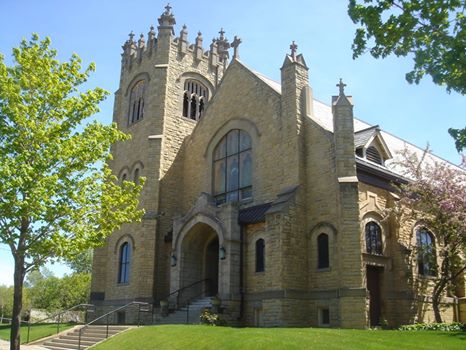
Lutheran Church of the Redeemer, Dale St and Carroll Ave. MHS collection

I have always had questions about why my father decided to join The Lutheran Church of the Redeemer on Dale Street. It may have had more to do with language than location.  Much of his early schooling and religious training was in German at Emanuel Lutheran, a Missouri Synod Lutheran congregation, on Saint Paul's West side.   In 1939,  he was newly married, and living at 65 Garfield Street, St. Paul.  It was probably at this time that he transferred his membership to Redeemer.  Redeemer was part of the English District, a non-geographical district of the Missouri Synod which was "distinctive among the many immigrant Lutheran congregations because they wanted to give their children the opportunity to worship and receive religious instruction in the English language."


Lutheran Church of the Redeemer from Carol Street


From the time I was born and baptized in 1941 through my confirmation and high school years, this was our church home.  We never lived near the church so transportation was always a problem, doubly so because Mother never learned to drive and either Dad drove or I took the street-car.  None of my school or neighborhood friends went to the church so there was no chance for ride-sharing.    

My father was a strict church attender and made few exceptions for not being in the church pew on a Sunday morning or a church holy day.  I especially never liked the Lenten season when we went to Wednesday and Sunday services and then Easter week added Maundy Thursday, three hours on Good Friday with the Easter Sunday Sunrise Service to top off one long week of church-attending.  And for all this you got a little potted plant to take home after the Sunday service to Mom, who was busy preparing the Easter Meal.  


The church was located in what was called the Old Rondo Neighborhood.  Rondo had served a number of ethnic groups, including Germans and Jews but in the years of the late 1940's, Saint Paul's Black population was concentrating here and was about 50 per cent of the total.   


Joseph Rondeau and his family moved to St. Paul after the family was forced out of their residence near Fort Snelling in 1840. They purchased the property and unfinished cabin of Edward Phelan, then in prison for the murder of John Hays. They lived there for a season or two while building a more suitable house.  Rondeau only stayed a few years but during that time encouraged a number of new immigrants to build on his land.   The Americanized version of his name Rondo was also used for the area’s main commercial street and eventually used to designate the entire area from Marshall to University and Rice to Lexington.  Some years later,  A. L. Larpenteur acquired a parcel of this land on which to build a country estate. 

Auguste Louis Larpenteur MHS


A.L. Larpenteur and
 First Post Office MHS
Auguste Louis Larpenteur, pioneer St. Paul, Minnesota settler, was born in Baltimore, Maryland on May 16, 1823, the son of Louis Augustine and Melinda (Simmons) Larpenteur. He came to St. Paul in 1843 and worked at the store of fur traders William E. Hartshorn and Henry Jackson as clerk and interpreter.  He spoke French and the local native language.  He was also assistant to St. Paul's first postmaster and was involved in the early government of the region. In the 1860's  Larpenteur built his country estate at the corner of Rondo and Dale

Larpenteur country estate at corner of Rondo and Dale  MHS.


The property, at that time, was outside the city limits.  The acreage was equivalent to 10 city lots and known as the Anchorage. He and his wife Mary Josephine continued to add to the house as their family grew to include 10 children. It stood until I-94 was constructed and the house gave way to "progress".   When the house was demolished by the city in 1963, part of the property was used to construct an 150-unit brick nursing home. It was later converted to senior housing. Redeemer Arms bought the building from the The Housing and Redevelopment Authority (HRA) in 1977.   Aunt Eleanor, Dad's sister, spent her last days here. 


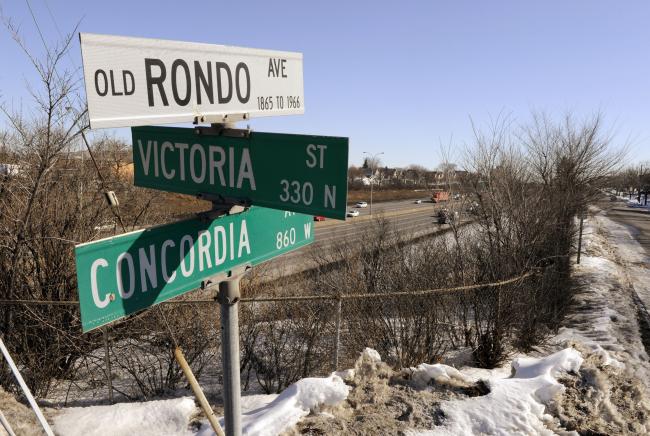
A sign for
A sign for "Old Rondo Ave.: 1865-1966"
stands atop other street signs overlooking
Interstate 94


Recently it was sold to Minneapolis-based Community Development Housing Corporation (CDHC), and after extensive renovation, was reopened as Dale Street Place Apartments.  


In the 1920's through 1940's the Rondo neighborhood was the only place to be if you were Black. "There they could own homes and run their own businesses with little interference from the whites, a rare thing in those days before the civil rights gains of the mid-1960s...we had grocery stores here, there were taverns here, there were restaurants, barber shops. A little bit of everything." 
from article by Patrick Condon in The Current April 2010 (read full article) 

The Rondo neighborhood in Saint Paul was named for Rondo Avenue, which ran east and west for about 1-1/2 miles from Rice Street to Lexington Avenue.  The neighborhood included the  parallel streets to the North and South. Rondo was six blocks North of Selby, and was exactly where Interstate 94 is today. This street and neighborhood were destroyed when construction began on Interstate Highway 94 between Minneapolis and Saint Paul in the 1950s.

Black Churches and social service agencies like Welcome Hall, Hallie Q. Brown Community Center, Inc. and Ober Boys Club were the center of the community. Social clubs were essential to the community because Blacks were not allowed in White-owned hotels, dance halls, or restaurants.

Before the forties a critical indication of social status in the community was by address. The houses at the east end of Rondo, between downtown and Western Avenue, were called Deep Rondo and made up the least desirable neighborhood. The area between Western and Dale was called Cornmeal Valley, the middle ground. West of Dale Street to Lexington Avenue was the more affluent area known as Oatmeal Hill.  

The corner of Rondo and Dale seemed to be where the action was.  Photographer, film-maker and composer, Gordon Parks is proudly claimed by St. Paul and the neighborhood as a former resident although he only spent a few years there.  He was raised in Kansas and when he was 15, upon the death of his mother, he was sent north to live with his sister in St. Paul.  He tells a story in his book, A Choice of  Weapons, about getting dressed up on Easter morning, with two of his buddies in identical forest green double-breasted suits, "the rest of the accessories : brown and white spectator oxfords, striped stiff-bosomed shirts, green ties and gray snap-brim hats" to stand on the corner of Rondo and Dale in front of Field's drugstore, "to give the world a break."

Author Evelyn Fairbanks has her own Rondo and Dale story.  Born in St. Paul, Minnesota, Fairbanks spent a year in Omaha, Nebraska with her natural mother (Eva Mae Riddle) before resettling in St. Paul with George and Willie Mae Edwards. She attended Mechanic Arts High School and became the first black employee at Hamline University in St. Paul, as a cashier.  Later Fairbanks received a bachelor's degree from the University of Minnesota at age 40. 

After the University, she wrote The Days of Rondo, a memoir of growing up in the 1930s and '40s in the thriving Rondo community, the largest Black neighborhood in St. Paul. In her book, she describes her Sundays.  "Every Sunday right after church, most of the black teenagers in St. Paul gathered at Field's drugstore on Rondo and Dale...   When I was sixteen one of my outfits was a grey wool walking suit with a three-quarter length coat, trimmed from neck to hem with silver fox fur, over a black chiffon long-sleeved blouse.  With it I wore a black felt hat with a large grey plume in the back, black  patent-leather high heeled shoes, and a black felt purse, and I carried wrist-length white gloves.  I mean we were dressed to kill"


Fairbanks moved to a 20-acre tree farm near the small town of Onamia, Minnesota after she retired in 1991. Pneumonia in 1993 slowed her down and her breathing was often labored because of asthma. In 1995, she received an honorary doctorate from Hamline.
About that same time, she began her research on Black pioneers in rural Minnesota, hoping to compile her research into a book.  When she died on March 21, 2001, she was working on a book contract; she was also learning Japanese and lecturing to school-age-children.


I got to know the landmarks of Dale Street quite well from the car window, but never ventured down the side streets, with the exception of the basketball games when our church team scrimmaged against one of the Hallie Q. Brown's teams.  Their team usually beat the pants off us.  At home I had perfected a shot for our garage mounted basket on our driveway court.  I would stand next to the house drain pipe, balance on the concrete splash block, and consistently swish the ball.   The shot, however, didn't translate well to the hardwood, and I was lucky if I scored a few points.  Speed and agility were never my strengths.  Hallie Q. Brown Center,  at that time was located on the corner of Aurora and Mackubin.  It relocated in 1972 to the Martin Luther King Center at 270 North Kent Street.  Almost every article or book you read on the Rondo neighborhood mentions the integral part that this center played for the residents through it's long history. 

On Sunday the family would pass through Frogtown and then the Rondo neighborhood before arriving at the church and parking either on Dale or Carroll streets.  We never had trouble finding a parking spot as Dad considered us late if we arrived a half hour before the service began.  Sunday School followed the service so it was always close to 3 hours before we were heading home.  

My "church friends" were all white and most had German names.  I can only think of one exception and that was Charles Avery, a young Black man who lived in the immediate neighborhood.  The Walther League youth group activities and the softball and basketball teams, sponsored by the church, made for some good times.


When I started attending confirmation classes in 1952, one of the sessions was held on Saturday morning.  Since Dad was often at work, it was usually up to me to get there and back via the street-car. 


The weekend street-cars only ran every half hour, so on the trip back home,  I would start walking north along Dale St. waiting for the big yellow street-car to arrive.  I loved the ride and still remember the woven seats, leather straps for holding on if the car was crowded,  and was especially fascinated by the token box which the conductor would continually wind to move the tokens down and into position.


Tiger Jack's shack at the corner of Dale St. and St. Anthony Avenue where he sold hickory chips, kerosene, shoe shines, vegetables and much more always looked interesting but I never ventured in and now I regret that I didn't.  MR. RESPECT is a documentary portrait of the late Tiger Jack Rosenbloom. Made by a class of sixth graders (see it here)

The use of  Tiger Jack as a symbol for the Rondo community is at best problematic.  Little mention is made of the professional doctors, lawyers and businessmen that called Rondo home.  Tiger Jack is the stereotype that whites can handle.  His shack and contents were donated to the Minnesota Historical Society, and in 2003 a one block section of Dale Street was named to honor Tiger Jack Rosenblum and his wife.  


If I made it as far as University Avenue before the streetcar caught up with me, I would forget about riding, pocket the dime, and keep on walking.  It was a little over 3 miles to home on Parkview Avenue from the church, so I still had a couple of miles to go, but there were plenty of things to see along Dale Street through the heart of Rondo and Frogtown.   


Dale Street Shops, Great Northern RR MHS

Further along, I would linger on the bridge over the Great Northern Railway yards just North of  Minnehaha Avenue.  It was a busy place with trains always on the move.  Today with few trains running , the area is called Great Northern Business Park and is home to many small shops and industries.  


a well used Lazy Ike 

But my favorite stop was at Joe's Live Bait where I always checked out the minnow tanks.  They knew me there since Dad and I were frequent minnow customers for our fishing trips to White Bear and Bald Eagle Lakes.  Of course Joe's was not on our way and there were other places to buy minnows near the boat rentals but Dad was a loyal customer and one of my perks was being able to survey the minnows, scoop out those floating belly up and eyeball the new red and white dare devils and Lazy Ike fishing lures.   


Charles Roger's photos in the Murray Pilot yearbook ca. 1956
and 1957
I recently discovered another Rondo community connection. My high school history /social studies teacher,  Charles Rogers lived there.   In a Rondo History oral interview, (read it here) conducted by Mr. David Taylor with Charles Rogers on Sept. 14 of 1997, Rogers describes the difficulty he had in getting housing in St. Paul. His first apartment was above Field's Drug Store at 620 Rondo, on the corner of Dale.  


Mr. Rogers was the first Black male teaching in the St. Paul public schools in the elementary school.  After teaching at both Maxfield and McKinley Elementary Schools, he moved onto Murray High School where he may have been the first Black working for this school in any capacity.  

I was in his classes during those first years and remember writing papers on the N.A.A.C.P and the Urban league and on labor unions.  His background as the Urban League's industrial relations secretary for the St. Paul chapter informed his teaching and provided a unique picture of the black person's urban struggles.   His class lessons were alternative history not found in the standard school books, a window on a different world.

Only after I graduated high school and left town, did Mom and Dad change their memberships to Bethel Lutheran Church on Wheelock Parkway, only a few blocks away from our home on West Parkview Avenue.  It was also a Missouri Synod Lutheran Church.

Dad also purchased a snow-blower since he lost his snow- shoveler to a college dormitory.