Saturday, July 2, 2022

The Dettwillers

My Paternal Grandmother Ella Emelia Schwartz was the daughter of Joachim “Joseph” Swartz and Caroline Dettwiller. She was born in Pecatonica, Illinois and married Fred Carl Glaeve in 1901 at St. John’s Lutheran in Pecatonic with Fred Schwengels and Augusta Swartz as their witnesses. 

                                                                                                                              Ella Emelia Schwartz

z ar 

Ella’s mother’s parents were Heinrich “Henry” Dettwiller and Charlotte Block. Both were from Dehlingen, Bas-Rhin, Alsace, France. They emigrated to America in 1856 via the Port of New Orleans. They came with 3 children: Charlotte born in 1847; Heinrich “Henry” Jr. born in 1849; and Caroline born in 1854. They lived in Granville, Milwaukee County, Wisconsin. After the Dettwillers arrival in America, more children were born. They were Catherine in 1857, Wilhelmina in 1859, Louise in 1861, Sophia in 1863. Christina in 1865 and William in 1868.


The Dettwilllers moved from Granville, Wisconsin to Burritt Township, Winnebago County, Illinois after the Jun 1, 1870 Census but before the 1875 founding of St. John’s Lutheran Church.


Original St. John's Lutheran Church


Winnebago County Map showing Pecatonica and Burritt townships


Charlotte, the oldest daughter married Joachim “Joseph” Meyers on August 1, 1969 in Milwaukee, Wisconsin. They moved to Pecatonica in Winnebago County and were there for the June 1,1870 Federal Census while her parents were still in Granville. Joseph wasfarming” and Charlotte was "keeping house." Joseph was the son of Johann Peter Gustav Meyer and Elizabeth Schockner and was born on the 16th of Jun, 1841 in Beestland, Demmin, Mecklenburg, Germany.

After arriving in Winnebago County, Heinrich Dettwiller became part of the group who founded St. John’s (German Lutheran) Church in Pecatonica. Before the church was founded, his wife Charlotte died on April 16, 1873 leaving Henry with, Caroline, Catherine, Christina, Henry Jr., Louise, Sophia, Wilhelmina, and William ages 19 - 5. She was buried in the Thompson Cemetery, Pecatonica, Winnebago County, Illinois.

Heinrich’s son William “Willie” born on April 21, 1868 in Granville died of diphtheria on February 1, 1877 in Pecatonica and is buried in Thompson Cemetery with his name inscribed on edge of Henrich and Charlotte’s stone.

Heinrich, who by 1880 was known as Henry, continued to live on the Burritt Township farm (location from the Atlas). In 1880 most of his children were still living with him.

His remaining daughters, Catherine, Louise, Wilhelmina, Sophia and Christina were all living at home and were working as maids in other houses during the day. Some may have boarded at their employers but don’t show up on the census. His son Henry (Jr.) had married Ernestine Rossow of Granville, Wisconsin on February 21, 1879 in West Bend, Washington County, Wisconsin. They resided in Pecatonica until 1900 when they moved to Ellendale, Shelby, Tennessee where both died and were buried.

Caroline married Joseph Frederick Christian Schwartz at St. John’s Lutheran Church on December 7, 1876. Joseph was born in Dargun, Mecklenberg and was another founder of St. John’s Lutheran Church. Their marriage was the first one performed in the newly organized church. They made their home in Pecatonica, Winnebago County, Illinois

Catherine married Frederick C. Kasch Sr. on May 5, 1881 at St. John’s Lutheran Church Frederick was from Mecklenberg. They made their home in Pecatonica, Winnebago County, Illinois

Sophia married Louis “Lewis” Albert Laabs/Loobs on April 12. 1883. Louis was born in Granville, Milwaukee County. They made their home in Pecatonica, Winnebago County, Illinois

Louise married John Rapean at John’s Lutheran Church on May 27, 1884. John was born in Griefenberg, Mecklenburg. They originally made their home in Winnebago County, Illinois but later moved to Stephenson County, Illinois

Wilhelmina “Minnie” married Christian Kasch, Frederic Kasch's brother, on March 31, 1888. Christian was born in Mecklenberg. They made their home in Pecatonica, Winnebago County, Illinois

Christine married Henry G. Bursick on November 24, 1892. Henry was born in Hesse, Germany. They made their home in Rockford, Winnebago County, Illinois

                                                         Henry and Charlotte's gravestone


Ger


Wednesday, June 29, 2022

Alternative spellings for Glaeve and Thompson Cemetery in Pecatonica Township, Winnebago Ill.

 Alternative spellings for Glaeve: Glawe, Glaf, Glave, Glaewe, Gläeve   

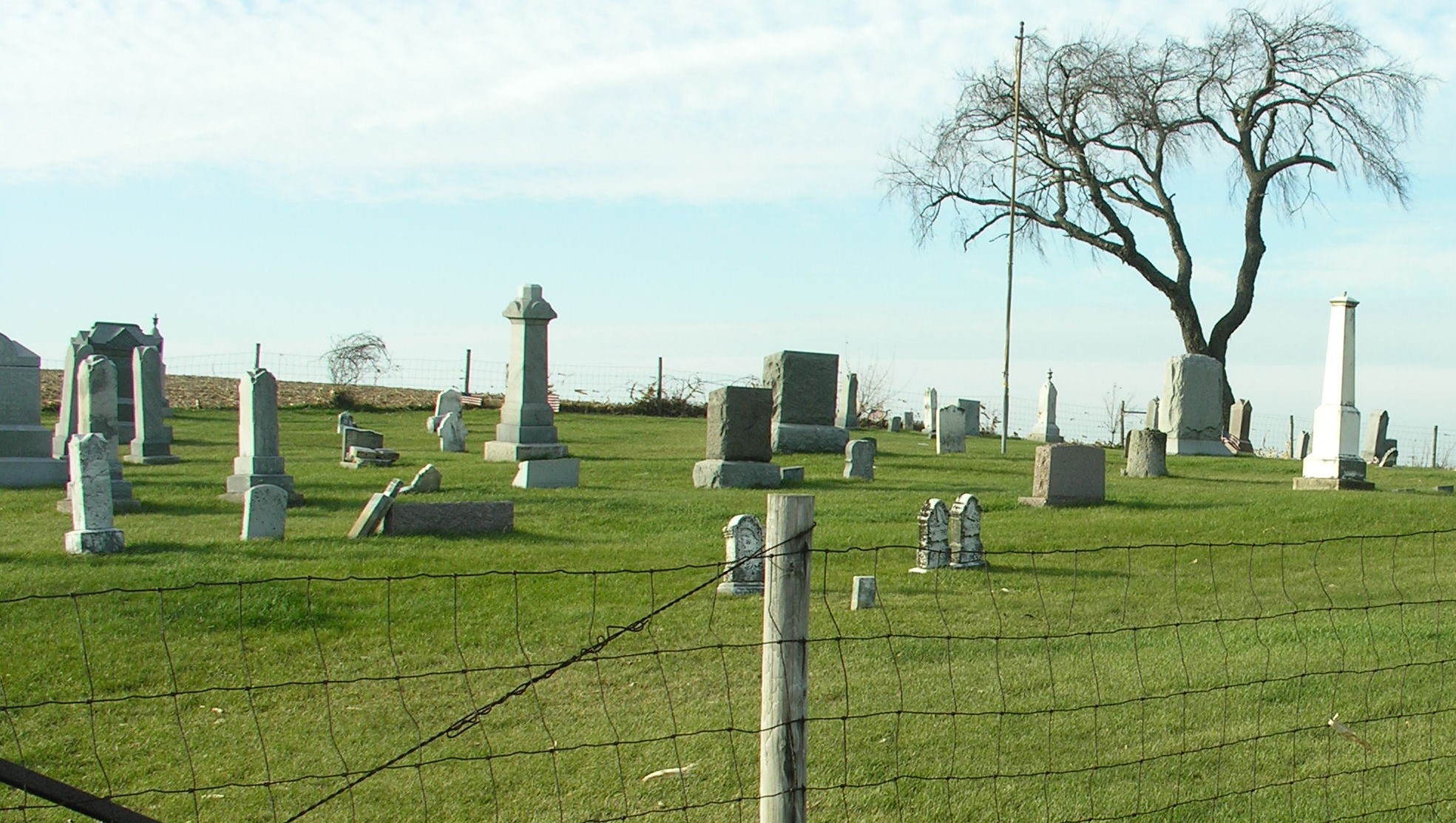
Shan made a contact with the village of Pecatonica to get directions to the Thompson Cemetery. The reply was very specific. "It is located on the West side of Ahrens Road which runs South off of Telegraph Road. There is no road into the cemetery nor alongside. You must park along Ahrens Road. It is nestled in farmland. It is a small cemetery with no name posted."

Thompson Cemetery from Ahrens Road


Thompson Cemetery from the side


A closer view


Joachim Christian Johann Glawe was born in Beestland, Pommern, Prussia (present day Germany). He died 24 Apr 1897 and is buried beside his wife, Maria, in Thompson Cemetery in Pecatonica, Illinois. His brother, Joachim Christian Johann Glawe (Glaeve)was also buried in Thompson Cemetery.

Grave Marker for Johann Carl Frederich Glawe (Glaeve) and portrait


 Joachim Christian Johann Glawe (Glaeve) is buried with wife Maria Meyer Glawe

Also buried in Thompson Cemetery is Joachim "Joseph" Friederic Christian Swartz 1851–1916 and his wife Caroline Dettwiller  


Thursday, June 23, 2022

Glaeve Sisters marry Schwengels Brothers

My Grandfather Fred Glaeve had two sisters who both married Schwengels

Martha married Fred Schwengels  on 7 Feb 1907 in Winnebago, Illinois 


      Martha and Fred's family


                     Children 
  1. Son Edwin John, 9 Oct 1907
  2. Son Theodore Otto "Ted", 18 Jul 1910
  3. Son Clarence E., 18 Apr 1916
  4. Daughter Ruth M. , 13 Nov 1917
  5. Daughter Ada Irene, 02 May 1920
  6. Son Leonard, 13 May 1923
  7. Son Howard Robert, 04 Jul 1925
  8. Son LeRoy Paul, 30 Sep 1926


               Minnie married John Schwengels on 04 Mar 1897 in Freeport, Illinois

Children

  1. Son Frederick Henry, 07 Feb 1899
  2. Son Herman Emil, 24 Jan 1901
  3. Daughter Anna, 07 Oct 1902
  4. Daughter Martha Sophia,   abt. 1905
  5. Son Martin, 30 July 1908
  6. Son Paul Gerhard, 19 Aug 1910
  7. Daughter Emma Wilhelmina, 19 Oct 1912
  8. Son John Albert, 12 Jan 1915
  9. Son Walter Robert, 13 Apr 1917 
  10. Son Warren E., 13 Mar 1923    
                         Minnie and John's 50th Wedding Anniversary 


     Five of the Schwengels Children: 
top row from left Walter, John, Warren, front row Emma and Fred

Minnie's Obit from the Janesville Daily Gazette, Saturday Dec. 20, 1958

Mrs. John Schwengels, 83, Darien, a former resident of Clinton, died at 2 a.m. Saturday in Lakeland Hospital. Death followed an illness of five days. The former Minnie Glaeve. daughter of Mr. and Mrs. Fred Glaeve, was born in Freeport, IL., Dec. 15, 1S75 and was married March 4, 1897 to John Schwengels.

They farmed in Winnebago County until moving to a farm south of Clinton in 1905. In '23, they purchased a home in Clinton, residingthere until '50 when they moved to Darien to make their home with a daughter, Mrs. Morgan Martin. She was a member of Christ Evangelical Lutheran Churchand the Lutheran Women's Missionary League.

Survivors are her husband; six sons, Fred, Janesville, Herman, Beloit, Paul, Waukesha, Walter. Clinton, John, Denver, Colo., and Warren, Mesa, Ariz.; three daughters, Mrs. Martha Reimer, Beloit, Mrs. Anna Simonson, Clinton, and Mrs. Morgan Martin; a sister, Mrs. Martha Schwengels. Rockford; 24 "grandchildren; 11 great-grandchildren.


Funeral services have been scheduled tentatively for 2 p.m. Monday in Christ Lutheran

Church, the Rev. John Stephan officiating. Burial will be in.Clinton Cemetery


Wednesday, June 22, 2022

The Nebermans of Freeport, Illinois


Great Grandfather Frederick Glaeve was born in 1841 in 
Beestland, Demmin,Mecklenburg-Vorpommern, Germany

 He was married to Maria "Mary" Fredericka Neberman in 1874. 

Birth of daughter Wilhelmina Marie "Minnie" Glaeve 
on 15 Dec 1875 in Freeport, Stephenson County, Illinois

Birth of Son Frederick Carl Glaeve
on 02 Apr 1878  Ridott, Stephenson, Illinois

Birth of last child, daughter Martha Lydia Fredricka Glaeve 
on 18 May 1888  Freeport, Stephenson, Illinois


He died on December 11, 1907, in Winnebago,
 Illinois, at the age of 66, and was buried in 
Winnebago, Illinois. Mary died on July 11, 1919
and is buried beside him. 

When Maria "Mary" Fredericka Neberman was born on April 29, 1851, in Schrödershof, Mecklenburg-Vorpommern, Germany, her father, Christian, was 35, and her mother, Maria, was 35. She had one son and two daughters with Frederick Glaeve between 1875 and 1888. She died on July 11, 1919, in Winnebago, Illinois, at the age of 68, and was buried in Winnebago, Illinois.

Her father Christian Joachim Friedrich Nebermann was born April 16, 1816 in Lussow, Gustrow, Mecklenburg-Vorpommern, Germany, He died on March 31, 1883 in Freeport, Stephenson, Illinois. 

other children of Christian and Maria were:
Fredericke 1840-1919
Johann F. 1847-1937
Sophia 1856-1886

Saturday, June 18, 2022

The kid sister


Kay was in one of the first classes in the new Como Park Junior High School. Originally opened in 1957, Como Park Junior High School was converted into a senior high school in the fall of 1979, accepting students from the just closed Washington and Murray High Schools, both of which became junior highs that same year.


Como Park Junior High School  ca 1957 MHS


Washington opened as a high school in 1929 and drew from a handful of public grade schools—Whittier, Rice, Smith, and Gorman—all of them now gone. As the only public high school in the North End, Washington was a community center and anchor, much the way high schools are in small towns. Fifty years after it opened, Washington was converted to a junior high and later a middle school. Many of my relatives including my mother and my sister attended Washington when it was a Senior High. 


The Hellers and others come from Burgenland to Columbus Township, Anoka County Minnesota

Many of the Burgenlanders who settled in Columbus Township, Anoka County, Minnesota, came from a small cluster of villages on the North East side of Lake Neusiedl.  

The families included Schotls from Monchhof, Altenburgers from Podersdorf,  Kreishitz/Kreitzs from Deutsch Jahrdorf,  Groess from Halbturn; Hellers from Halbturn; Thurnbecks from St. Andras and more.  I previously published a blog about Burgenland with information about the individual villages and the spread-sheet that Shan created, "People we think are Burgenlanders in Columbus Township"  (see that spread-sheet and blog here


Frauenkirchen, Church of Maria auf der Heide

To get an idea of the size of the area, the distance from Frauenkirchen to Halbturn is 6 km.; to Podersdorf 7.9 km. to Monchhof 5.6 km.; to Tadten 11.2 km.  


We know that Anton Heller was  born in Halbturn, Burgenland  in 1851.  He married Maria Hershelder in 1877, when he was 26 years old.  Together with children Joseph Mary, and Katherine they sailed on the ship Zaandam which departed from Amsterdam, on April 24, 1886. 

It appears that they went directly to Columbus Township, Anoka County, Minnesota.  At the time of the 1900 Federal Census, they were living on their farm with their 3 children; Joseph, Mary, and Katherine.


In the 1905  State Census, Anton, Maria and their daughter Katherine were still living on the farm. Son, Joseph and daughter-in-law, Marie Lunzer lived on the next farm where they also farmed 80 acres.


Columbus Township,  Anoka County,  MN 1914

At the time of the 1910 Federal Census, Anton, Marie and their daughter, Katherine lived on the family farm on Holl and Nolz Road. Anton and Marie had 9 children only 3 of whom survived.

Anton died at age 63, and is buried in Calvary Cemetery, Forest Lake, Washington County. The Find A Grave Memorial# is 132145281


Mary survived him by 13 years.  She moved in with her son Joseph and daughter-in-law Mary.  We find her there in the 1920 Federal Census. 

Mary died in 1927 at age 70 and was buried next to Anton in Calvary Cemetery, Forest Lake. The Find A Grave Memorial # is 132145263.


Shan pointed out that the two 40 acre parcels on the left side, of what was called Schotl Road in the 1910 Federal Census, were owned by Math Schotl (blue highlight).  The two 80 acre parcels on the right side of the road had been the original Heller farms owned by Anton and Joseph Heller.  

Friday, June 17, 2022

The Frogtown Neighborhood of St. Paul

The first German Bohemians came to St. Paul in the early 1870s and settled in the German ethnic neighborhoods that ring the downtown area of the city and joined the downtown German Catholic parish of the Assumption. 

Church of the Assumption St. Paul


Their Czech neighbors from the old country were also their neighbors in the new country.

"Nearly all ethnic German parishes is St. Paul, Minnesota, held Bohmisch families, including St. Agnes, St Francis de Sales (near the Czech community centered at St. Stanislaus along West Seventh Street) St. Bernard's (Rice Street) Sacred Heart (Dayton's Bluff) and St. Matthew's (West Side)"
The largest concentration of German-Bohemians in St. Paul was in the Frogtown neighborhood just north of the downtown business district.  

                                                  Map of the Frogtown area of Saint Paul


These German Bohemians immigrated from small villages in the forested areas of Southwest Bohemia , the Böhmerwald (Sumava).  There were many from the small village of Glockelberg (Zad Zavonka).  The neighborhood was called Frogtown or Froshbberg by the German-speaking immigrants who populated the neighborhood, 
because of the large number of frogs that inhabited this marshy area of the city."
  "This immigrant neighborhood was centered on the beautiful church of St. Agnes.

                                               Recent photo of St. Agnus Catholic Church
 

German-language sermons, hymns and confessions lingered well into the 1950s.   Social events often centered around churches, card clubs, men's clubs, women's clubs, sewing circles, sauerkraut suppers and booyas..."  German was the language of the home and the street.  "The local business establishments, taverns, grocery stores, bakeries, butcher shops, hardware stores, tailor shops, barber shops, pharmacies and mortuaries displayed the German names of their German proprietors on their marquees."

Today, Frogtown is considered a subsection of the Thomas-Dale neighborhood.  It is bordered by University Avenue on the south, the Burlington Northern Railroad tracks to the north, Lexington Parkway on the west and Highway 35 E on the east.   More information here,       "Frogtown or Thomas Dale". Ramsey County Historical Society.  2008-07-22
 
Bob Paulson and Shan Thomas at the Minnesota Historical Society
                
                                                                                   
We know that Robert Paulson, founder of, and Research Committee chair of the German-Bohemian Heritage Society (GBHS) has been doing research on German-Bohemians in the Frogtown area.
 
A 2005 article written by Paulson and Linda Therkelsen in Heimatbrief  states that  "The church records of St. Agnes are laced with German-Bohemian names. " ... Paulson says "I discovered from the Catholic Church records of St. Agnes Parish in St. Paul, Minnesota, that a large group of emigrants from Kreis Krummau, Kaplitz, Budweis and Prachatitz also settled in that parish during the last half of the 19th century."  Some of the St. Agnes parishioners  joined St. Bernard's when it was founded in 1890 on the Eastern edge of Frogtown.

One of the few books on Frogtown is the book by Alex Leibel titled In Those Days, Recollections of Frogtown.  The book "traces ... misadventures of a young boy born to German immigrants in a small section of St. Paul...


 The memoirs are primarily of the 1930s and 40s during a period the author refers to as the golden age of Frogtown. It was an era when the immigrants were settled in and raising their large families beneath the sheltering baroque steeple of their Catholic church, their focal point sustaining them in that historic time with its two epoch events, the Great Depression and World War II." [from the synopsis provided by the publisher]  

I did find a Facebook listing for Frogtown and through it found some entries from Dorothy Paulson,  wife of Robert Paulson.


She grew up in the area, attended St. Agnes Catholic Church and St. Agnes Schools through high school.   According to Dorothy Paulson, "The three Catholic churches in Frogtown formed a sort of triumvirate: Saint Agnes was German; Saint Adalbert's was Polish; and Saint Vincent's was considered the Irish parish."

                                         Street View ca. 1930 of St. Agnus Catholic Church